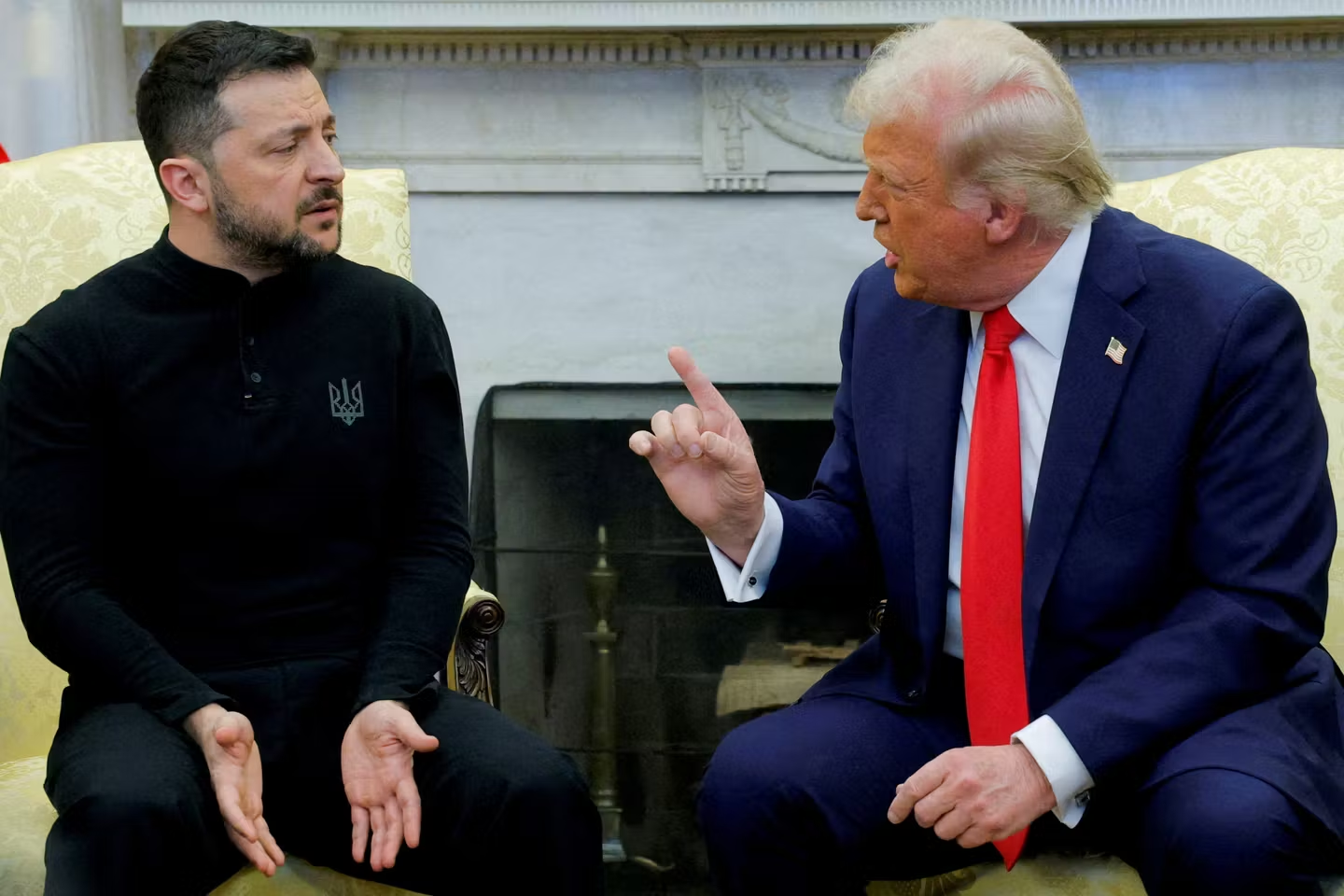
The upcoming Zelensky Trump meeting in Florida marks one of the most significant diplomatic moments since the start of Russia’s full-scale invasion of Ukraine in 2022. Ukrainian President Volodymyr Zelensky confirmed that he will travel to the United States on Sunday for direct talks with former US President Donald Trump. This meeting is expected to focus on a new US-backed peace plan, American security guarantees for Ukraine, and an evolving set of proposals that could shape the future of the war.
For nearly three years, the conflict has reshaped global politics, revolutionized European security priorities, and created enormous humanitarian and economic challenges. Yet, despite continuing hostilities and ongoing military operations, the announcement of these high-level talks has introduced fresh momentum to the diplomatic track.
Washington, Kyiv, and Moscow have all intensified discussions in recent weeks. Negotiators on each side have exchanged proposals, expressed reservations, and signaled openness to compromise. Against this backdrop, the Zelensky Trump meeting appears to be a pivotal moment that could determine whether a stable peace framework is achievable.
This article examines the context of the meeting, the key issues at stake, reactions from world leaders, and the challenges that remain in negotiating a durable settlement.
Why the Zelensky Trump Meeting Matters Now
The significance of the Zelensky Trump meeting lies not only in the content of the discussions but also in the timing. The war has reached a stage where diplomacy is again seen as a viable alternative to perpetual conflict. Several factors have converged to make this moment strategically important.
1. Stalemate on the Battlefield
The front lines in eastern and southern Ukraine have barely shifted in the past year. Both armies have suffered heavy losses. Ammunition shortages, equipment fatigue, and mobilization challenges have slowed offensive operations. Winter conditions have further hardened the stalemate.
This static battlefield environment has increased pressure on all parties to explore political options. The lack of decisive military gains has made negotiation more appealing, especially for countries providing financial and military assistance.
2. Shifting US Policy and Growing Influence of the Trump Team
The United States continues to play a central role in shaping Ukraine’s war strategy and future security arrangements. Trump’s renewed diplomatic involvement has introduced a bold change in tone. In a recent interview with Politico, Trump said Zelensky “doesn’t have anything until I approve it,” highlighting the growing influence of the Trump team in foreign-policy discussions.
Trump also stated that he expects to speak with Russian President Vladimir Putin “soon,” suggesting Washington intends to negotiate directly with Moscow. This shift has encouraged both Ukrainian and Russian officials to accelerate dialogue in anticipation of new American proposals.
3. Rising Humanitarian and Security Risks
Recent Russian missile and drone attacks on Kyiv and Kharkiv demonstrate that civilians remain vulnerable. Two people were killed in Kharkiv after an overnight strike. Explosions were also reported in Kyiv, where authorities urged residents to seek shelter.
These attacks are not isolated. They reflect the continuing danger to millions of Ukrainian civilians and underscore the urgency of establishing a ceasefire.
4. Global Economic Pressure
The war has raised prices for energy, grain, and industrial materials. Europe has struggled with energy diversification. Russia has faced sanctions and export restrictions. Ukraine’s economy has contracted severely due to infrastructure damage and displacement.
Stability in the region is now seen as essential for global economic recovery, making diplomatic progress a priority.
Inside the Peace Proposals for the Zelensky Trump Meeting
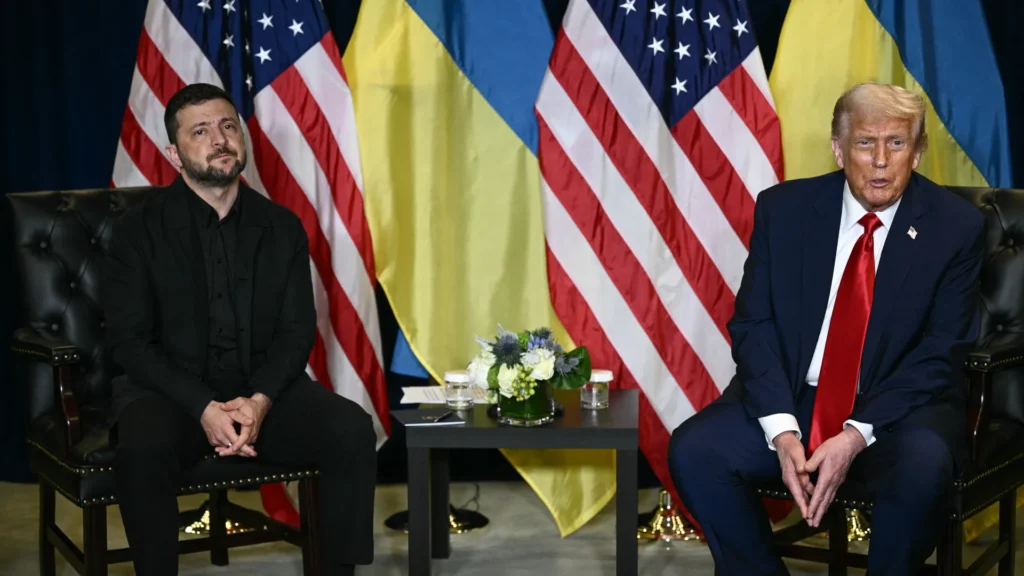
The Zelensky Trump meeting will revolve around two central topics:
1. A US-brokered 20-point peace plan
2. Long-term American security guarantees for Ukraine
Zelensky has stated that the plan is 90% complete. The remaining issues include territorial control, the future status of Donbas, and arrangements for the Zaporizhzhia nuclear power plant.
Below are the main points expected to shape the negotiations.
A Demilitarized Zone in Eastern Ukraine
One of the most significant proposals in the US plan is the creation of a demilitarized buffer zone across eastern Ukraine. This would require both armies to withdraw troops a specific distance from the current front line. Zelensky indicated that Ukraine could pull back up to 40 km, but only if Russia withdraws an equal distance.
This buffer zone would reduce the risk of direct confrontation and create a foundation for future economic cooperation. Zelensky has even suggested turning this area into a “free economic zone,” encouraging international investment and rebuilding efforts.
However, this concept challenges Russia’s longstanding demand for full control over Donbas. Moscow currently occupies:
- 75% of Donetsk
- 99% of Luhansk
The Kremlin has repeatedly said Ukraine must withdraw entirely from the region. Therefore, the demilitarized zone remains one of the most difficult issues in the negotiations.
The Future of the Donbas Region
Donbas has been the core battleground and political flashpoint since 2014. The region holds symbolic, strategic, and economic value for both sides. As a result, it is the most challenging issue in the Zelensky Trump meeting.
Ukraine’s position has recently shifted. Zelensky signaled that a limited territorial compromise could be possible, but only under strict international guarantees. His offer to pull back troops from certain areas is a major concession.
Russia, however, views Donbas as central to its national identity narrative. Putin insists that Ukrainian forces must leave the region entirely. This rigid stance makes compromise difficult, but not impossible, especially if the United States offers strong incentives.
Security Guarantees Modelled on NATO’s Article 5
A major component of the plan is US and European security guarantees. Under the proposal, Ukraine would receive protection similar to Article 5 of NATO, where an attack on one is considered an attack on all.
This would deter future Russian aggression while stopping short of full NATO membership. Zelensky views these guarantees as essential, especially after three years of war.
Russia strongly opposes this idea. Moscow argues that such guarantees would formalize US military influence in Eastern Europe and prevent Russia from securing its own security perimeter.
Still, Washington believes that long-term stability requires permanent international oversight.
The Zaporizhzhia Nuclear Power Plant
As Europe’s largest nuclear power station, the Zaporizhzhia facility is crucial. Russian forces currently control it, raising safety concerns and giving Moscow leverage.
The US proposal suggests both countries share the plant’s energy output. This would preserve Ukraine’s grid stability while reducing the risk of military escalation around the facility.
Zelensky and Western allies support this compromise. The Kremlin, however, has not signaled approval.
The Role of Trump’s Negotiators in the Peace Process
Zelensky revealed that he held an hour-long conversation with Steve Witkoff and Jared Kushner on Christmas Day. This discussion produced new ideas and helped refine the peace plan.
Witkoff previously drafted a 28-point proposal that many criticized for favoring Russia. The updated draft includes several Ukrainian-backed revisions, making it more balanced.
Kushner’s involvement signals that Trump intends to place trusted advisers at the center of the negotiation process. Their deep ties to international business networks may also influence future economic reconstruction strategies.
Russia’s Reaction to the Zelensky Trump Meeting
Senior Russian officials have responded cautiously. Kremlin negotiator Kirill Dmitriev recently returned from Florida, where he held discussions with US representatives. Deputy Foreign Minister Sergey Ryabkov described the developments as positive but expressed doubt about Ukraine’s intentions.
Ryabkov accused Kyiv of trying to “torpedo” the talks, although he did not provide evidence. His comments highlight Russia’s suspicion toward Ukrainian diplomacy and its preference for direct US-Russia dialogue.
Foreign ministry spokeswoman Maria Zakharova was more direct. She accused Western European nations of interfering in the process and undermining peace efforts. She also rejected several elements of the US proposal, especially territorial questions and military guarantees.
Despite these objections, Moscow is still participating in back-channel discussions, suggesting that it is interested in a negotiated settlement — but only on terms it finds acceptable.
Trump’s Vision and the US Strategic Perspective
Trump has expressed confidence that he can negotiate successfully with both Zelensky and Putin. He believes that both leaders will respond positively to American pressure and incentives.
In his recent interview, Trump said:
“I think it’s going to go good with him. I think it’s going to go good with Putin.”
This statement reflects his belief that a balanced agreement is possible. It also suggests that Washington intends to take a more assertive role in shaping the future of Ukraine.
Netanyahu’s expected visit to Florida adds another dimension. Trump appears to be gathering a coalition of leaders to shape post-war reconstruction strategies.
European and NATO Reactions
Europe remains divided. Some nations support the US plan, welcoming Washington’s diplomatic leadership. Others worry that the plan may pressure Ukraine into a compromise that benefits Russia.
NATO Secretary General Jens Stoltenberg has emphasized that Ukraine’s sovereignty must remain intact. European Union leaders insist that Russia must withdraw troops for any agreement to succeed.
However, many European governments recognize that the war cannot continue indefinitely. Economic disruptions and refugee pressures are growing. A US-led peace initiative offers a potential exit from the conflict.
Economic and Humanitarian Implications of a Ceasefire
A ceasefire would have immediate and long-lasting effects:
1. Reduced Civilian Casualties
Millions of Ukrainians could return home. Cities like Kharkiv, Odesa, and Zaporizhzhia would experience relief from constant air-raid sirens.
2. Stabilized Global Markets
Energy prices, grain exports, and industrial supply chains would normalize.
3. Massive Reconstruction Projects
Ukraine will require billions in reconstruction funds. Western companies, Gulf investors, and European banks are expected to participate.
4. Shift in Regional Power Dynamics
A stable peace agreement would reposition Eastern Europe within the global geopolitical order.
Challenges Ahead for the Zelensky Trump Meeting
Despite the optimism, many obstacles remain:
1. Territorial Disputes
Russia refuses to give up occupied territories. Ukraine refuses to surrender sovereignty.
2. Security Guarantees
Russia opposes NATO-style protection for Ukraine.
3. Trust Deficit
Years of war have created deep mistrust between the nations.
4. Domestic Politics
Both Zelensky and Putin face internal pressure. Any compromise could affect their political stability.
5. International Stakeholders
Europe, China, Turkey, and the UN must also be considered.
Potential Scenarios After the Zelensky Trump Meeting
Scenario 1: Breakthrough Agreement
Both sides approve the US plan, leading to a ceasefire and phased troop withdrawal.
Scenario 2: Partial Agreement
Only certain issues are resolved, delaying a final settlement.
Scenario 3: Stalled Negotiations
Talks fail due to territorial disagreements.
Scenario 4: Increased Escalation
If diplomacy collapses, military operations may intensify.
Conclusion: A Defining Moment in the Peace Process
The Zelensky Trump meeting represents a rare and powerful opportunity to reshape the course of the Russia-Ukraine war. For the first time in months, all sides seem willing to explore compromise. The involvement of high-level negotiators, the urgency created by recent attacks, and the growing economic burden of war have combined to create a diplomatic window that cannot be wasted.
Whether this meeting produces an immediate breakthrough or simply advances the conversation, it will mark a turning point. The world will be watching closely as Zelensky and Trump sit down in Florida to discuss the future of one of the most consequential conflicts of the century.
If peace is to come, it may begin with this meeting.
