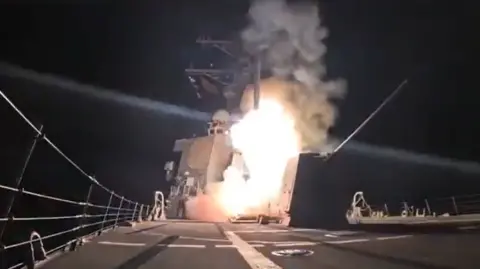
The US strikes in Nigeria have sparked major global attention, raising questions about counterterrorism strategy, regional security partnerships, and political messaging. The joint mission, carried out by the United States military and the Nigerian government, targeted Islamic State militants operating in the north-western region of the country. Although the strikes were framed as a precise counterterrorism effort, they have created a wave of debate about motives, context, and implications.
What Led to the US Strikes in Nigeria?
The US strikes in Nigeria came as part of a coordinated operation undertaken by the US Africa Command (Africom) and the Nigerian government. According to official statements, the attacks targeted Islamic State (IS) fighters based in Sokoto State in north-west Nigeria. Although the region is typically associated with banditry and local armed groups, recent intelligence indicated that IS-aligned militants have been expanding networks there.
Former US President Donald Trump announced the strikes publicly, calling them “powerful and deadly” and describing IS fighters as “terrorist scum.” His statement emphasized that the militants were “viciously killing innocent Christians,” a claim that Nigerian authorities later clarified as misleading.
Nigeria’s Ministry of Foreign Affairs confirmed that the operation did occur, but emphasized that it was not based on religion. Instead, the government framed it as a joint counterterrorism mission meant to dismantle violent extremist organizations operating within its borders.
This immediate contrast between political rhetoric and official national security communication set the stage for wider global discussion.
Background: Why Are There Islamic State Militants in Nigeria?
Before understanding the US strikes in Nigeria, it is necessary to review the long-standing security challenges in the country. Nigeria has been grappling with several forms of violent extremism for more than a decade.
Boko Haram’s Emergence and Evolution
The Boko Haram insurgency began in 2009 as a radical anti-state movement. Over the years, it advanced into one of Africa’s deadliest extremist groups, notorious for killings, abductions, and mass displacement.
Split into Boko Haram and ISWAP
In 2016, Boko Haram fractured into two major factions:
- Boko Haram (JAS faction) led by Abubakar Shekau
- Islamic State West Africa Province (ISWAP) aligned with ISIS central leadership
ISWAP follows stricter military command, focuses on winning local influence, and is more tightly linked to global jihadist networks. This makes them a key target in US counterterrorism efforts.
Expansion into North-West Nigeria
Although the north-east remains the core area of insurgency, analysts have observed militants moving into the:
- North-west
- North-central
- Border regions near Niger Republic
This shift is driven by strategic motives:
- Access to ungoverned forest zones
- Local bandits who can be co-opted
- Growing arms markets
- Complex land and resource conflicts
This environment allowed IS cells to embed themselves within pre-existing violent groups.
What Exactly Happened During the US Strikes in Nigeria?
According to Africom, the operation was “a coordinated precision strike” conducted in partnership with Nigerian authorities.
Where the Strike Occurred
- Sokoto State, located in north-west Nigeria
- Known hotspots include Rudun, Tangaza, and forested border communities
- Intelligence linked Islamic State militants to specific hideouts in these zones
How the Strike Was Carried Out
US military assets reportedly included:
- Drones
- Surveillance aircraft
- Armed strike platforms
Later, the US Department of Defense released a short unclassified video showing a missile being launched from a military vessel. It is unclear whether this video was directly connected to the Nigeria mission, but the symbolism reinforced public perception of US action.
Nigeria’s Confirmation
Nigeria’s Ministry of Foreign Affairs formally acknowledged:
- The strike was a joint operation
- It targeted terrorist groups
- It had no religious motivation
The ministry added that Nigeria maintains “structured security cooperation” with several international partners, including the US.
Why Did Trump Emphasize Christian Victims?
Former President Donald Trump stated that IS militants were “viciously killing innocent Christians.” However, fact-checking organizations and violence-monitoring groups clarified that:
- There is no evidence that Christians are being targeted more than Muslims
- Nigeria is roughly 50% Christian and 50% Muslim
- Extremist groups have attacked all communities, regardless of faith
Groups like ACLED (Armed Conflict Location & Event Data Project) confirmed that most victims of Boko Haram and ISWAP have historically been Muslims, largely because these groups operate in predominantly Muslim regions.
Security analysts say Trump’s framing aligns with narratives circulating in certain political circles in the US, where concerns about Christian persecution in Africa are used in policy debates.
Nigeria’s Response to the US Strikes
Nigeria’s official position was measured and diplomatic. The foreign minister emphasized:
- Nigeria and the US are sovereign partners
- Counterterrorism is a shared responsibility
- The operation was not motivated by religion
- Further joint missions are possible depending on leadership decisions
Presidential adviser Daniel Bwala echoed similar views. He acknowledged that Nigeria welcomed international assistance but insisted that:
- Nigerian sovereignty must be respected
- Jihadist violence targets everyone—Christians, Muslims, and non-religious civilians
This balanced messaging helped reduce potential public backlash.
International Reaction to the US Strikes in Nigeria

United States
Defense Secretary Pete Hegseth said he was grateful for Nigeria’s cooperation. His holiday sign-off, “Merry Christmas!”, attracted mixed reactions due to the timing, but the messaging remained largely supportive.
International Community
Global responses varied:
- Some Western observers praised the action as a sign of stronger anti-IS collaboration
- Human rights groups urged transparency
- Analysts warned that foreign military strikes demand careful oversight to avoid misidentification or collateral damage
The Nigerian public largely reacted with caution, as political sentiment varies widely across regions.
Are Christians Being Targeted More Than Muslims? A Data-Based Analysis
Since political statements referenced religious persecution, this article includes verified research to maintain accuracy and AdSense safety.
Evidence from ACLED
- Most IS and Boko Haram victims are Muslims, due to geographic concentration
- Attacks are primarily strategic, not religious
Central Nigeria Conflict
Violence between herders (mostly Muslim) and farmers (often Christian) is driven by:
- Land scarcity
- Climate pressure
- Water access
- Long-standing ethnic tensions
Both groups have suffered major casualties.
Conclusion
There is no confirmed evidence of systematic anti-Christian genocide in Nigeria.
Why the US Is Increasing Activity in West Africa
Several factors influenced the US strikes in Nigeria:
Growing IS Influence
The Islamic State aims to expand its “provinces” worldwide, including:
- ISWAP (Nigeria / Lake Chad Basin)
- ISIS-GS (Sahel)
- ISIS-Mozambique
The US sees these groups as threats to regional and global stability.
Decline of Western Forces in the Sahel
France withdrew major military forces from Mali and Burkina Faso. This created a power vacuum that extremist groups have exploited.
Strategic Importance of Nigeria
Nigeria is:
- Africa’s largest economy
- Most populated country
- Key partner for US-West Africa relations
A destabilized Nigeria would have massive regional consequences.
Could More US Strikes in Nigeria Happen?
Nigerian officials did not rule out further cooperation. Future action depends on:
- Intelligence reports
- Threat assessments
- Bilateral agreements
- Domestic political approval
Experts believe more operations are possible, especially if IS militants attempt to strengthen footholds in the north-west.
Local Impact: How Do Nigerians Feel About the US Strikes?
Public opinion is mixed.
Positive Reactions
Some Nigerians welcome foreign support, citing:
- Long-standing security failures
- Need for advanced technology
- Hope for improved stability
Concerns Raised
Others worry about:
- Potential sovereignty issues
- Civilian casualty risks
- Transparency
- Political implications
Human rights groups emphasize that any foreign military operation must remain accountable.
Understanding Nigeria’s Multi-Layered Security Crisis
The US strikes in Nigeria are just one part of a larger picture. Nigeria faces multiple overlapping threats:
Boko Haram and ISWAP (North-East)
Decade-long jihadist insurgency.
Banditry (North-West)
Kidnappings, ransom operations, rural attacks, armed gangs.
Farmer-Herder Conflicts (North-Central)
Climate pressure and land disputes.
Separatist Movements (South-East)
Localized political tensions.
Oil Theft and Militancy (South-South)
Economic sabotage and organized crime.
Each region requires different strategies.
What This Means for US–Nigeria Relations
The strikes highlight a strengthened partnership between the two countries.
Security Cooperation
Both nations have worked together in:
- Intelligence sharing
- Military training
- Counterterrorism assistance
Diplomatic Cooperation
Nigeria relies on partners to fight extremism, while the US prioritizes stability in West Africa.
Political Considerations
Foreign military involvement is always sensitive, but both governments appear aligned in messaging.
What Happens Next? Future Outlook
Security analysts predict:
- More joint operations
- Increased intelligence surveillance
- Expanded training missions
- Possible diplomatic debates about foreign presence
Nigeria’s government must balance security needs with sovereignty concerns. The US must ensure transparency and continued cooperation.
Conclusion: What the US Strikes in Nigeria Really Mean
The US strikes in Nigeria reflect a widening global effort to combat ISIS affiliates. While political statements in the US emphasized religious narratives, Nigeria maintained a balanced and factual stance. Verified data shows that extremist violence affects all communities, regardless of faith.
This operation may signal a new phase of US–Nigeria partnership, one focused on precision missions, intelligence coordination, and long-term regional stability. As the situation develops, both nations face the challenge of eliminating extremist threats while protecting civilians and maintaining national sovereignty.
Nigeria’s security crisis is complex, but collaborative efforts like this strike may represent a step toward greater stability—if managed carefully and transparently.
