A New Round of US Russia Ukraine Talks Begins in Miami
The geopolitical spotlight shifted to Miami this weekend as high-level delegations from the United States and Russia held a fresh round of negotiations aimed at finding a path toward ending the prolonged Ukraine war. These US Russia Ukraine talks mark one of the most direct diplomatic engagements between Washington and Moscow in recent months, taking place at a time when the battlefield situation remains volatile and global pressure for de-escalation continues to grow.
Russian President Vladimir Putin’s special envoy, Kirill Dmitriev, met with US President Donald Trump’s envoys — Steve Witkoff and Jared Kushner. Dmitriev confirmed that the discussions were “constructive”, expressing optimism that the dialogue would resume on Sunday with renewed momentum.
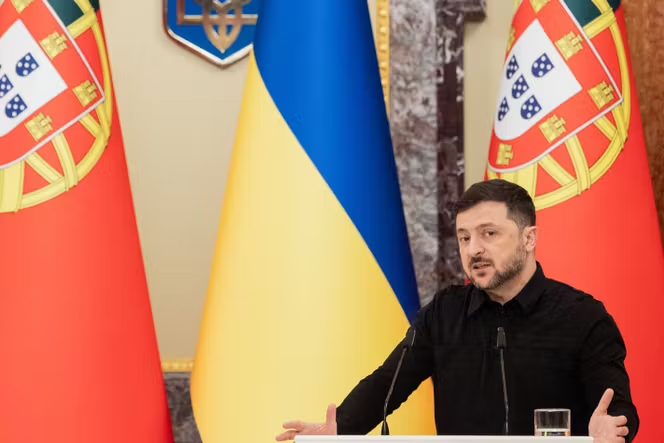
Meanwhile, Ukrainian President Volodymyr Zelenskyy encouraged Washington to apply stronger pressure on Russia, arguing that diplomacy alone may not be enough to bring Moscow to the negotiating table in a meaningful way. These developments highlight the complex balance between diplomacy, military actions, territorial disputes, and international power dynamics.
In the following in-depth report, we examine the details of the Miami talks, the perspectives of each nation involved, the obstacles ahead, and the potential implications for global security, European stability, and the future of Ukraine.
Background of the US Russia Ukraine Talks
Since Russia launched its full-scale invasion of Ukraine, diplomatic interactions have fluctuated between occasional breakthroughs and prolonged standstills. The latest US Russia Ukraine talks in Miami come after weeks of secret negotiations involving American, Ukrainian, Russian, and European representatives. According to officials, a 20-point peace proposal is currently under discussion.
Although progress has been made, major disagreements remain — particularly regarding territorial control, security guarantees, and long-term geopolitical commitments.
The Miami sessions reflect Washington’s renewed attempt to mediate, especially as the war continues to place immense strain on European unity, global energy markets, and humanitarian conditions across Eastern Europe.
These talks also come at a moment when Russia believes it holds significant tactical advantages on the battlefield, while Ukraine is under mounting pressure due to limited Western military support and intensifying Russian attacks on key infrastructure.
Inside the Miami Negotiations: Who Is Involved?
Russian Delegation Led by Kirill Dmitriev
Kirill Dmitriev, a key figure in Russian diplomacy, described the conversations as “proceeding constructively.” His presence underscores Moscow’s desire to engage directly with US officials despite ongoing tensions and sanctions. Dmitriev’s statements suggested cautious optimism, although he refrained from offering specifics on the points discussed.
US Delegation Led by Steve Witkoff and Jared Kushner
Representing the United States were Steve Witkoff, a senior envoy, and Jared Kushner, long involved in international negotiations during Trump’s previous administration. Their involvement signals a strategic shift in the US approach — focusing on back-channel diplomacy while maintaining an official negotiating framework.
Possible Participation of Secretary of State Marco Rubio
US Secretary of State Marco Rubio revealed that he may join the talks depending on how the dialogue progresses. Rubio acknowledged that significant progress has been achieved in the current round of US Russia Ukraine talks, yet stressed that substantial work remains.
He highlighted a central goal: identifying areas of overlap where Russia and Ukraine could potentially reach agreement. However, he also cautioned that such overlap may be difficult to achieve given both nations’ entrenched positions.
Zelenskyy’s Position: Diplomacy With Pressure
Ukraine’s View on the US Russia Ukraine Talks
President Zelenskyy said he remains supportive of US-led diplomacy but insisted that negotiations must be paired with “full pressure” on Moscow. According to him, Vladimir Putin does not yet feel the level of pressure necessary to compel meaningful concessions.
Zelenskyy welcomed the idea of US-mediated trilateral talks involving national security advisers from Ukraine, the United States, and Russia. However, he expressed skepticism, suggesting that previous talks yielded limited results despite high expectations.
Potential Benefits for Ukraine
Zelenskyy hinted that he would support talks if they can help achieve:
- Prisoner-of-war exchanges
- Improved humanitarian corridors
- A future meeting of national leaders
- New security guarantees
- Advancement in peace negotiations
He also emphasized that Ukraine will not accept any agreement undermining its territorial integrity or political sovereignty.
Territorial Disputes: The Biggest Obstacle in the US Russia Ukraine Talks
Russia’s Position
Russia continues to demand control over territories it occupies, claiming strategic and historical justification. Russian officials believe they can secure these territories due to shifting battlefield momentum and perceived weakening of Western unity.
Ukraine’s Position
Ukraine maintains that:
- All occupied regions must be returned.
- Security guarantees must be internationally binding.
- NATO membership or equivalent protection must be ensured.
These opposing stances remain the deepest and most contentious issue overshadowing the Miami talks.
Recent Military Escalations Complicate Negotiations
Russian Attacks in Odesa and Black Sea Region
As the Miami talks progressed, Russian missile attacks continued across Ukraine. An overnight ballistic strike on Odesa’s port infrastructure resulted in:
- 8 deaths
- 30 injuries
- Destruction of civilian infrastructure including a bus
Prime Minister Yulia Svyrydenko described the attacks as targeted strikes that caused widespread damage, leaving thousands without electricity or heating in freezing temperatures.
Ukrainian Counter-Operations
Ukraine’s security agency, the SBU, claimed responsibility for destroying:
- Two Russian fighter jets in occupied Crimea
- A Russian Caspian Sea oil rig
- A patrol naval vessel nearby
These operations reflect Ukraine’s strategy of targeting high-value Russian assets, especially those supporting military operations.
US Russia Ukraine Talks: A 20-Point Peace Framework
Although exact details remain confidential, sources suggest the proposal includes:
- Ceasefire arrangements
- Demilitarised buffer zones
- Withdrawal timelines
- Territorial status negotiations
- Prisoner exchanges
- Humanitarian corridors
- International monitoring
- Energy infrastructure security
- War crimes accountability
- NATO–Russia de-escalation measures
- Reconstruction partnerships
- Economic sanctions recalibration
- Security guarantees for Ukraine
- Maritime navigation agreements
- Missile range restrictions
- Civilian evacuation plans
- Diplomatic normalisation roadmaps
- Information warfare restraints
- Black Sea security frameworks
- Long-term peace treaty structure
While some points show promise, the most sensitive issues — territory and long-term security guarantees — remain unresolved.
US Russia Ukraine talks: Why the Miami Meeting Is Important for Global Politics
These US Russia Ukraine talks are one of the most significant diplomatic initiatives since mid-2024. Their outcomes have implications far beyond Ukraine.
1. European Security and NATO Stability
A prolonged conflict threatens NATO’s eastern flank and increases pressure on European logistics, economies, and political structures.
2. Global Energy Markets
Russia’s actions in the Black Sea and Caspian Sea directly affect:
- Oil shipping routes
- Natural gas infrastructure
- Global commodity prices
A peace agreement could stabilise markets.
3. International Diplomacy
If successful, these talks may evolve into a replicable model for resolving future international conflicts.
4. Humanitarian Relief
Millions of Ukrainians remain displaced. Ceasefire progress could accelerate humanitarian aid and reconstruction.
Russia’s Perspective After Recent Military Gains
President Putin claimed that Russian troops are gaining ground and that the “special military operation” remains on course. He again justified the invasion as a measure to prevent NATO expansion and demilitarise Ukraine, repeating arguments that Western nations strongly reject.

Putin also suggested that Russia might pause attacks to allow Ukraine to conduct presidential elections — an idea Zelenskyy dismissed as political manipulation.
Ukraine’s Domestic and International Position
Despite battlefield hardships, Ukraine maintains strong domestic support for sovereignty. Internationally, Kyiv insists that:
- Territorial concessions are unacceptable.
- Peace must not reward aggression.
- Security guarantees must be ironclad.
Zelenskyy continues engaging with global leaders to reinforce support from NATO members, the EU, and other allies.
Challenges Facing the US Russia Ukraine talks
The obstacles are enormous:
1. Russia’s Territorial Demands
The Kremlin believes it can secure long-term control of occupied territories.
2. Ukraine’s Need for Security Guarantees
Kyiv cannot accept a deal that leaves it vulnerable to future attacks.
3. US Domestic Politics
Shifts in US leadership influence foreign policy direction and negotiating leverage.
4. European Fatigue
Some European allies are increasingly divided over long-term military support.
5. Continued Military Escalation
Each new attack reduces trust and complicates diplomacy.
Possible Outcomes of the Miami Talks
While many scenarios remain possible, analysts highlight three major pathways:
Scenario 1: Framework Agreement Without Ceasefire
Diplomats agree on broad outlines but require months of additional negotiation.
Scenario 2: Temporary Humanitarian Ceasefire
Focused on prisoner exchanges, humanitarian corridors, and infrastructure.
Scenario 3: Talks Collapse
Territorial disputes remain unresolved, leading to intensified conflict.
Will These Talks Lead to Peace?
Although the Miami discussions show promise, history demonstrates that US Russia Ukraine talks are often slow, complicated, and vulnerable to external shocks. Yet, even partial progress — such as agreements on prisoners or security coordination — could lay the foundation for more significant breakthroughs in the future.
Zelenskyy’s cautious support, combined with Washington’s sustained diplomatic effort, suggests that all parties recognize the urgency of pursuing peace, even if the path ahead remains uncertain.
A Critical Moment for Diplomacy: US Russia Ukraine talks
The Miami negotiations represent a rare moment of direct engagement between global powers who hold the keys to ending Europe’s most devastating conflict since World War II. While the talks remain fragile, their constructive tone offers a glimmer of hope.
As the world watches closely, one thing is clear: the US Russia Ukraine talks in Miami are not just another diplomatic meeting — they are a pivotal step in determining the future political landscape of Eastern Europe and the wider world.
Whether these talks lead to real progress or become another missed opportunity will depend on political will, international unity, and the ability of each party to compromise without compromising sovereignty and security.
