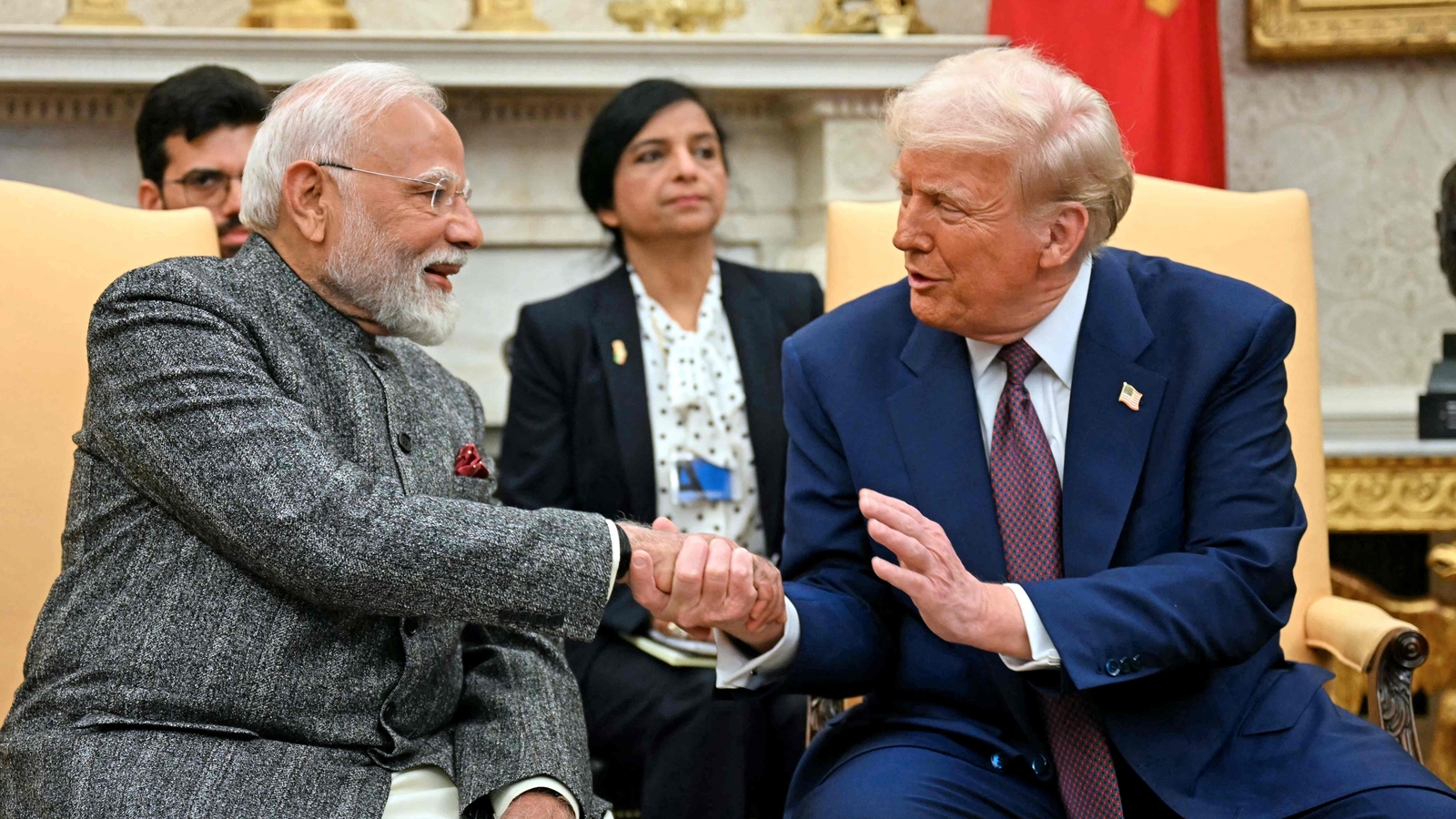
Trump Modi Tariff Warning: The relationship between the United States and India has often moved through cycles of strong cooperation, strategic alignment, and periodic disagreements. This pattern resurfaced recently when former US President Donald Trump issued a strong tariff warning to India soon after praising Prime Minister Narendra Modi as a “very good man.” His remarks, made aboard Air Force One, came at a crucial moment when officials from both countries were attempting to ease long-standing trade tensions.
This report provides a detailed, neutral, and comprehensive account of the issue. It also examines the broader geopolitical context, particularly the ongoing debate around India’s oil imports from Russia. The situation reflects the delicate balance New Delhi must maintain between its national energy needs and the expectations of global partners like the United States.
Trump Modi Tariff Warning Emerges During Sensitive Trade Talks
The Trump Modi Tariff Warning became a prominent talking point in diplomatic circles after the former US President stated that the United States could “raise tariffs on India very quickly” if New Delhi continued importing Russian oil. His comments immediately created international headlines because they were made during a crucial phase of bilateral trade negotiations.
Background of Trump’s Statement
While interacting with reporters aboard Air Force One, Trump asserted that he was unhappy with India’s continuing energy ties with Russia. According to him, Prime Minister Modi was aware of his displeasure. Trump claimed that India subsequently reduced its oil imports from Moscow because it wanted to maintain smooth relations with Washington.
“We could raise tariffs on India if they don’t help on the Russian oil issue… PM Modi’s a very good man. He knew I was not happy, and it was important to make me happy.”
This combination of praise and pressure has been typical of Trump’s diplomatic style. He frequently mixes appreciation for foreign leaders with firm warnings about policy decisions that he considers harmful to US interests.
The current remark, however, is more significant due to its timing—coinciding with a fresh round of trade negotiations between India and the United States.
Trade Negotiations Resume Amid the Trump Modi Tariff Warning
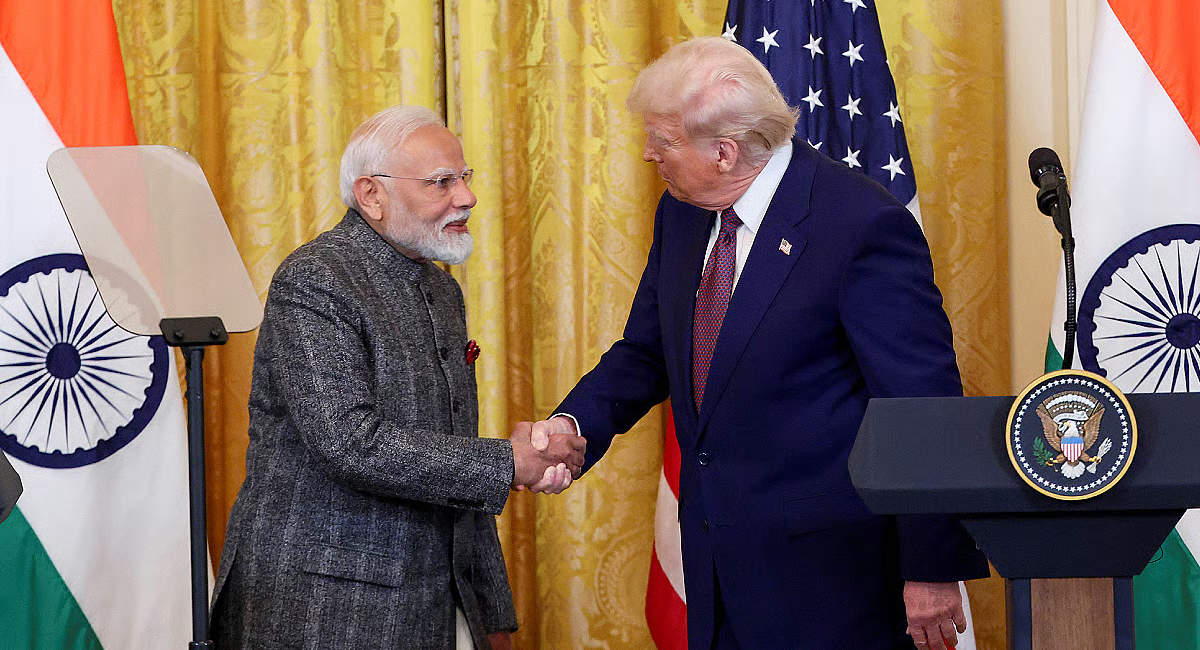
Officials from New Delhi and Washington began a new round of talks aimed at resolving persistent trade issues. These discussions were essential because both nations had experienced tensions over tariffs imposed in the previous years.
Recap of Past Trade Disputes
The US imposed additional tariffs on several categories of Indian imports, with the rates in some cases reaching nearly 50 percent. India responded with retaliatory tariffs, leading to a prolonged impasse. Although both sides expressed a desire to find common ground, political developments and economic priorities often slowed progress.
The Trump administration had earlier removed India from the Generalized System of Preferences (GSP), which allowed duty-free access for certain Indian goods. The decision affected billions of dollars in trade and prompted further negotiations that remain unresolved even today.
ALSO READ: Trump’s $100,000 H-1B Fee Sends Shockwaves Through US H-1B Visa News and Global IT Industry
Importance of the Current Negotiation Round
The renewed talks between the two countries signal recognition that the trade partnership is too important to be stalled. India is one of the fastest-growing markets in the world, and the United States views New Delhi as a vital partner in the Indo-Pacific region. The Trump Modi Tariff Warning has added new tension, but both governments continue to push for progress.
Trump Continues to Praise PM Modi Despite Tariff Warning
Even while expressing dissatisfaction over India’s Russian oil imports, Trump emphasized his positive relationship with PM Narendra Modi. He described the Indian leader as “a very good man” and “a good guy.” This kind of praise is consistent with several statements Trump has made about Modi during and after his presidency.
Trump’s Public Statements About India
Trump has often spoken highly of India on various occasions. In a recent message highlighted by the US Embassy in India, he wrote:
“India is home to one of the world’s oldest civilizations. It is an amazing country and an important strategic partner for America in the Indo-Pacific region. We have a great friend in PM Modi.”
This messaging shows a mix of strategic appreciation and personal warmth. It is also likely intended to reassure India that despite occasional disagreements, the United States remains committed to maintaining a strong partnership.
Diplomatic Reactions
India has not issued an official reaction to Trump’s latest comments. However, experts believe that New Delhi will continue its balancing approach. Indian officials have consistently stated that energy security is a national priority and that domestic needs must come first.
At the same time, India has shown flexibility by reducing some Russian oil shipments when geopolitical pressures intensified.
Russian Oil At the Centre of the Trump Modi Tariff Warning
The Trump Modi Tariff Warning is tied directly to concerns about India’s continued import of Russian crude oil. The United States has repeatedly urged allies to reduce their dependence on Moscow in the wake of geopolitical tensions.
India, however, has maintained that its energy purchases are based on affordability and national interest
India’s Position on Russian Oil
India is one of the world’s largest importers of crude oil. A significant portion of its supply comes from foreign markets because its domestic production is limited. After Western sanctions on Russia led to discounted oil prices, India increased purchases to ensure stable supplies at competitive rates.
Indian officials have clarified:
- India does not support any geopolitical conflicts.
- Purchases from Russia are strictly economic.
- Affordable oil is essential for its population and industries.
- India has diversified its energy sources, not relying solely on any one country.
US Stance on India’s Energy Choices
The United States has acknowledged that every country must protect its national interests. Yet Washington also urges partners like India to support global efforts aimed at reducing economic flows to Russia.
Trump’s remarks fall within this broader policy discussion. His warning reflects long-standing concerns rather than a new position.
Spotlight on Venezuela’s Oil Resources
The broader geopolitics of oil also came into focus after recent events involving Venezuela. The United States carried out a strike targeting Venezuelan interests, drawing attention to the country’s massive oil reserves.
Venezuela’s Oil Production Scenario
Venezuela holds more than 303 billion barrels of proven oil reserves—the largest in the world. This represents around 17 percent of global oil supply, according to estimates from OPEC.
Yet its production has declined sharply due to:
- US sanctions
- Political instability
- Underinvestment in energy infrastructure
Current production reportedly hovers around 1 million barrels per day, far below its potential output. These disruptions have contributed to shifts in global oil markets, making energy-importing countries like India even more dependent on diverse supply routes.
Why Venezuela Matters in the Trump Modi Tariff Warning Context
Trump’s comments indirectly connect to this global situation. When major producers like Venezuela reduce output, nations turn toward other exporters, including Russia. This creates a complicated geopolitical landscape where any country’s economic decisions quickly become part of broader diplomatic debates.
India’s Balancing Act Between Global Powers
The Trump Modi Tariff Warning highlights India’s continuous efforts to maintain balanced relationships with global powers. New Delhi works with the United States on strategic, defence, and economic issues, while also cooperating with Russia on energy, security, and technology
Strategic Relations With the United States
India and the US have strengthened cooperation in:
- Defence
- Trade
- Technology
- Indo-Pacific strategy
- Counterterrorism
- Semiconductor production
Despite occasional disagreements over tariffs or energy imports, both countries understand the long-term value of their partnership.
Historic Ties With Russia
India’s relationship with Russia dates back decades. Moscow has been:
- A major defence supplier
- A partner in energy exploration
- A supporter in international forums
Therefore, India’s approach is rooted in long-term strategic calculations rather than short-term diplomacy.
How the Trump Modi Tariff Warning May Influence Future Trade Talks
The tariff threat may complicate ongoing negotiations, but experts believe that both sides will continue engaging constructively.
Potential Impact on India
India may:
- Re-evaluate the pace of its Russian oil purchases
- Seek more clarity on Washington’s expectations
- Negotiate tariff safeguards
- Reinforce its energy security arguments
Potential Impact on the US
For Washington, maintaining strong ties with India is essential. The US sees India as a key counterweight in the Indo-Pacific region. Therefore, Washington may adopt a practical approach that balances political pressure with strategic cooperation.
International Community Reacts to the Trump Modi Tariff Warning
Global analysts have expressed diverse views on the Trump Modi Tariff Warning.
Supporters of Trump’s Position
Some analysts argue that Trump’s tariff approach could push India to align more closely with Western energy policies. They believe tariffs are a proven tool in US trade diplomacy and may encourage India to diversify its oil sources further.
Critics Raise Concerns
Others believe that tariff threats could:
- Damage bilateral trust
- Slow trade negotiations
- Push India to deepen ties with other energy partners
- Create market instability
Most experts, however, agree that both nations benefit more from cooperation than confrontation.
Trade, Energy and Global Politics Intertwined
The Trump Modi Tariff Warning is a reminder of how deeply trade, energy, and geopolitics are connected. A single policy decision in one country can set off ripples across multiple continents.
India’s Economic Priorities
India continues to focus on:
- Affordable energy
- Stable economic growth
- Strengthening global partnerships
US Global Strategy
The United States aims to:
- Strengthen alliances
- Prevent adversaries from gaining economic advantage
- Maintain influence in global energy markets
Both objectives intersect in the ongoing debate around Russian oil.
India and the US Likely to Maintain a Balanced Partnership
Although the Trump Modi Tariff Warning has drawn global attention, experts believe that India and the United States will continue strengthening their partnership. Differences over energy imports or trade policies may cause friction, but they are unlikely to derail long-term cooperation.
The relationship between these two democracies is built on shared strategic interests. Therefore, diplomatic engagement, mutual respect, and pragmatic decision-making will likely guide future developments.
Both sides appear committed to resolving their trade disagreements while advancing broader strategic goals.
