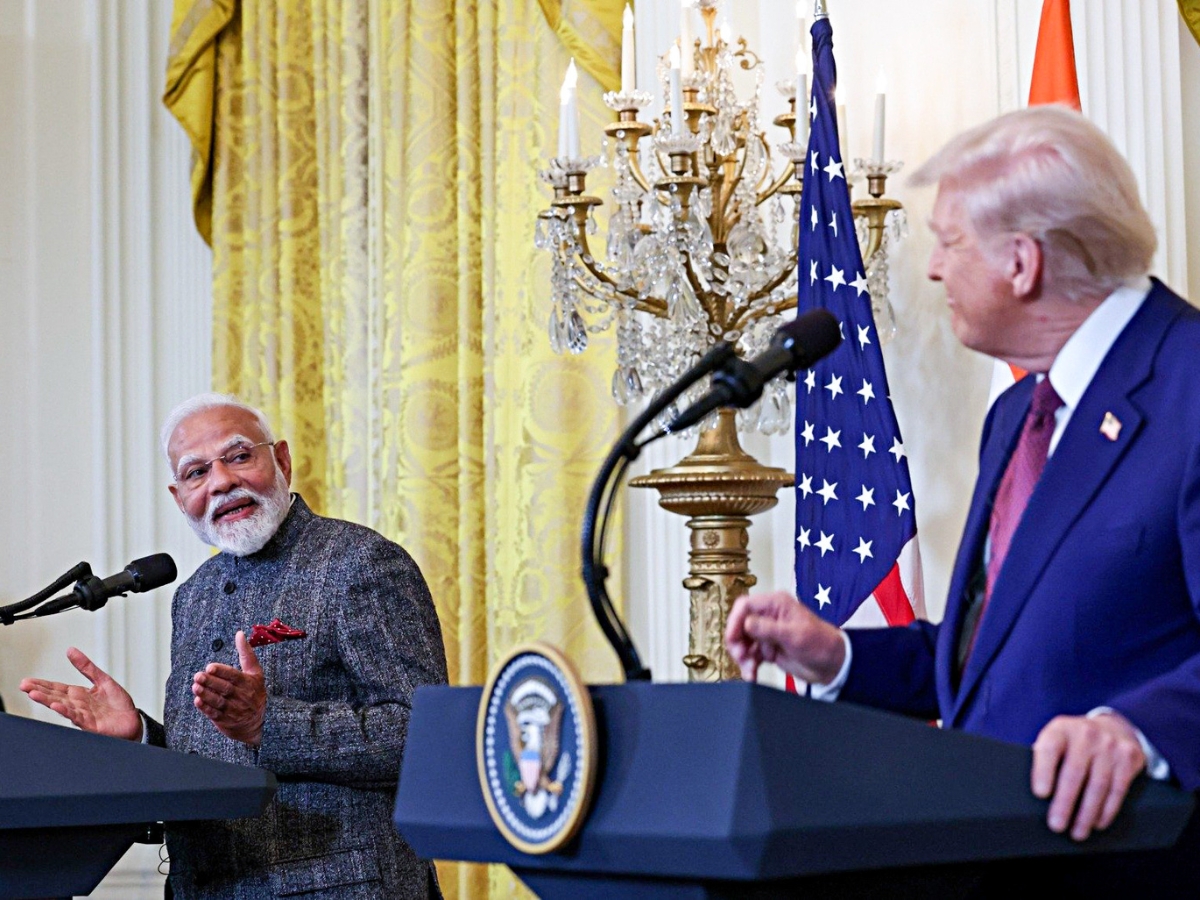
Trump C5 grouping: Growing Curiosity Around the Trump C5 Grouping There may be a new global grouping in the works that Washington is considering. According to the reports, former United States President Donald Trump, who is now back in charge, is thinking of creating a super-exclusive high-power bloc comprising the US, India, China, Russia, and Japan. This potential structure, which is being called the Trump C5 grouping, is attracting worldwide attention. While the White House has not confirmed anything, the reports have led to worldwide discussions about the geopolitical and economic systems of the future.
The very idea of such a program signals a potential upheaval of worldwide partnerships and prompts questions about the continued existence of such forums as the G7. The idea was first revealed in the Politico article, which mentioned that the concept was found in a more extended and unpublished version of the National Security Strategy. It is quite normal for governments to have different drafts of their major policy documents. Still, the White House has rejected the notion of any other or secret version. The main reason why the idea has attracted so much attention is that it has a lot of far-reaching geopolitical consequences.
Background: What the Trump C5 Grouping Represents
It is the objective of the proposed Trump C5 grouping to unite the five global powers whose influence span worldwide. These are the countries that not only have a huge number of people, but also big militaries and strong economies, and together they have the power to shape the world. To put it simply, they would have at their disposal a new official forum to meet, discuss, and negotiate. The issues that the group is said to tackle are global security, energy and regional conflicts.
The group of five (G5), as the reports explain, would not focus on any of the usual factors, such as politically democratic and economically developed countries, but instead, be more inclined to power, population, and geopolitical influence. If this happened, it would be a significant difference from the G7 model. The G7 comprises the richest, most democratic countries of the West, plus Japan. Hence, the setting up of the G5 would signal a change in the way of looking at international relations—one that does not take into account ideological factors but instead prioritizes realpolitik.
Origins of the Idea: What Politico Reported About the C5 Grouping
The articles talking about the Trump C5 grouping claim that the idea was found in a more extended version of the 33-page National Security Strategy. The official version does not contain such a proposal. Politico declared that it could not confirm on its own the existence of the longer draft. However, it referred to the Defense One article, which reports that it has seen the excerpts of the extended strategy.
The report says that the C5 would include the USA, China, Russia, India and Japan. Altogether, these five countries represent over half of the global population. Besides, they have considerable military and economic capabilities. This mix points at a group that could be the most direct in dealing with global challenges. The Politico article said that the newly-formed C5 would be supposed to have as frequent meetings be similar to the G7’s, where leaders could get together for summits on worldwide topics.
The first topic of conversation for the C5, as envisaged, is reportedly the security of the Middle East. It would cover the normalisation of the relationship between Israel and Saudi Arabia, among other things. This kind of development would, therefore, have the most significant impact on regional stability.
White House Response: No Confirmation of a C5 Grouping
The White House has been very vocal in its rejection of the idea of an alternative version of the National Security Strategy. Press secretary Hannah Kelly, when questioned about the Politico article, said that there was “no alternative, private, or secret version” to the document. She went on to say that the only version that should be referred to is the one that was published, which is the 33-page strategy.
In spite of this rejection, the Trump C5 grouping idea is still being talked about. Several political commentators have opined that this notion is consistent with Trump’s past foreign policy. His first term in office was characterized by a focus on bilateral deals and direct negotiations with powerhouses. It also showed that he preferred pragmatic rather than formal alliances.
Why the Trump C5 Grouping Sounds Plausible to Experts
A number of experts in national security have come to the conclusion that the idea of a Trump C5 grouping goes well with Trump’s worldview. For instance, Torrey Taussig, who was the director for European affairs at the National Security Council under the Biden administration, argued that Trump generally examines foreign policy matters from a non-ideological point of view. Ms. Taussig explained that Mr. Trump sees global cooperation in terms of a few strong nations joining forces.
Besides that, Taussig pointed out that the authors of the paper somehow forgot to consider Europe in the potential group. The absence of European countries may evoke worries that the administration perceives Russia as a dominating force in Europe’s sphere. Even though these worries are only hypothetical, they represent the general apprehension felt in Europe about their role in the changing global order.
The other expert, Michael Sobolik, drew attention to the fact that the idea of C5 is quite the opposite of the approach that Trump used to have in his first-term concerning China. During his earlier presidency, Trump was on the hard-line side when it came to competing with China. US policy towards China under the Trump administration was framed around strategic rivalry. However, the C5 proposal would see China as one of the few countries cooperating closely. Mr. Sobolik referred to this as a “massive change” from previous policies.
International Reactions: Growing Concerns Among US Allies
There have been some concerns expressed by several US allies after the reports emerged about the Trump C5 grouping. Many Western countries are trying to figure out to what extent the current administration is going to change the world order. For a very long time, organizations such as NATO, the G7, and the G20 have been the pillars of international relations. The formation of the C5 could be a catalyst for change in this balance.
Some US allies are uncomfortable with the idea that the new bloc may serve to legitimise despotism in certain countries. They argue that putting Russia in the center of the group instead of Europe might lead to the disintegration of the West. Also, a bloc that has both China and Russia can be considered as a threat to the strategic unity of alliances such as NATO.
Another issue touched upon is the way decisions are made in such a small group. A small group of powerful nations can reach decisions without having a say of the rest of the world. This makes one wonder about the openness, responsibility and inclusiveness of such decisions.
How the Trump C5 Grouping Could Impact Global Politics
In case of its enforcement, the Trump C5 grouping would be a signal of a significant change in world-wide diplomacy. It would be the alliance of five countries that hugely influence the direction of world politics. Each one of these nations is driven by its strategic goals. So, having them all in one place means that they could easily talk through issues that are now very complicated and they have to use many intermediaries to get in touch with one another.
The possible C5 would be committed to talking about hard-power topics such as national safety, fuel provision, ensuring peace in the region, and settling disputes. Such issues almost always call for the most powerful nations to be in concert. So, the formation of a stable platform for talks could be helpful in smoothing outhanding agreements and raising cooperation levels.
Still, such an ensemble would also amend the importance of those platforms that exist already. For instance, the G7 would have less power if the C5 turned into a new centre for making decisions of equal status. In the same vein, the G20 might find its influence diminished because the C5 is the place where the biggest players are gathered whose joint action leads to global results.
India and the Trump C5 Grouping
Regarding the potential Trump C5 grouping, India would be a vital part of this configuration. India is not only one of the fastest-growing economies in the world but also a major geopolitical player. It makes a trio of good friends and each of them is the US, Russia, and Japan. Although India is connected to China as well, it keeps its relations peacefully with the rest. This equilibrium turn out India to be a very powerful factor in her favor.
Indian officials remain silent on the matter. Meanwhile, the experts argue that India might consider such a group as a stepping-stone towards greater influence over global governance. Being a member of the C5 would open doors for India to actively engage in the talks that determine international security and economic trends.
Moreover, that forum may serve as an enabling factor for India in the world of multiple centers of power. India has been a staunch advocate of the democratization of global decision-making for quite some time now. C5, with its focus on the largest population centres and the powers holding crucial positions in the strategies, is a demonstration of the multipolar model.
