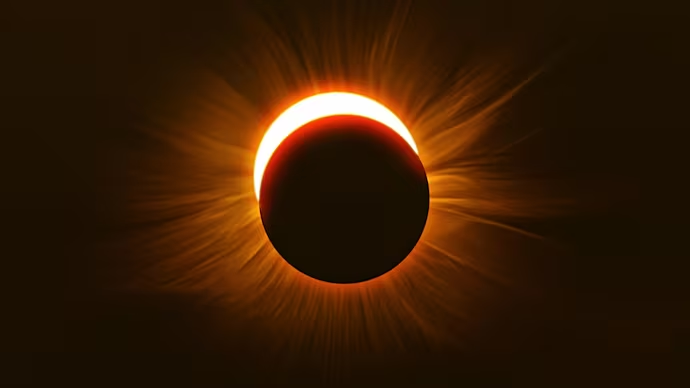
What is Surya Grahan and Why Timing Matters
Surya Grahan timing is one of the most searched topics whenever a solar eclipse approaches. And honestly, who wouldn’t be curious? Imagine the Moon slowly covering the Sun, turning bright daylight into an eerie twilight. It feels dramatic, mysterious, and almost magical. But beyond the visual wonder, the exact Surya Grahan timing plays a crucial role for scientific observation, religious practices, and even safety measures.
A Surya Grahan, or solar eclipse, happens when the Moon comes between the Earth and the Sun. This alignment blocks sunlight either partially or completely for a short period. Now here’s the catch — this alignment must be precise. Even a slight difference in positioning can change the type of eclipse and its timing.
Why does Surya Grahan timing matter so much? First, visibility depends entirely on timing and geographical location. An eclipse visible in Delhi at 2:15 PM may not appear the same way in Mumbai. Second, in India, religious rituals and Sutak Kaal start and end based on exact eclipse timing. Even a difference of a few minutes can change temple schedules and fasting practices.
From a scientific perspective, researchers depend on exact Surya Grahan timing to study the Sun’s corona, solar flares, and atmospheric changes. Photographers, astronomers, and sky watchers also rely heavily on minute-by-minute updates.
In short, Surya Grahan timing isn’t just a clock event. It’s a cosmic appointment. Miss the time, and you miss the moment. And when nature performs such a rare show, you definitely want to be on time, right?
Surya Grahan Timing in India (City-Wise Details)
Surya Grahan timing in India varies from city to city because the eclipse path does not cover the entire country equally. The Earth rotates, and the Moon’s shadow moves across different regions at different times. So if you’re in Chennai, your Surya Grahan timing may differ slightly from someone in Jaipur.
For example, during a partial solar eclipse expected in 2026, tentative Surya Grahan timing in India may look like this (illustrative timing):
| City | Eclipse Start | Maximum Eclipse | Eclipse End |
| Delhi | 2:05 PM | 3:12 PM | 4:28 PM |
| Mumbai | 2:11 PM | 3:18 PM | 4:32 PM |
| Kolkata | 1:58 PM | 3:05 PM | 4:20 PM |
| Chennai | 2:15 PM | 3:22 PM | 4:36 PM |
These timings can vary slightly depending on astronomical calculations released closer to the date. That’s why checking official astronomical data before the event is important.
Now, here’s something interesting. Even if Surya Grahan timing starts at the same hour nationwide, the percentage of the Sun covered can differ. In northern India, the eclipse might appear more prominent compared to southern regions.
Weather also plays a huge role. Clear skies allow better visibility, while cloudy weather can block your view completely. So along with checking Surya Grahan timing, keep an eye on weather updates.
Planning to watch it? Mark your city’s specific Surya Grahan timing in advance. Set a reminder. Prepare your protective glasses. Because when that shadow begins its slow journey across the Sun, you won’t want to be scrambling for information.
Date and Duration of Surya Grahan 2026
The upcoming Surya Grahan timing in 2026 is expected to create significant excitement among sky watchers. According to astronomical predictions, the solar eclipse in 2026 will occur on August 12, 2026. However, the exact Surya Grahan timing and visibility will depend on your geographic location.
Typically, a solar eclipse lasts for about 2 to 3 hours from start to finish. But here’s something most people don’t realize: the period of complete darkness during a total solar eclipse may last only a few minutes. That brief moment, known as totality, is the highlight of the entire event.
Let’s break down the duration phases:
- First Contact – The Moon begins to cover the Sun.
- Maximum Eclipse – The peak point when the Sun is most covered.
- Last Contact – The Moon moves away, and sunlight fully returns.
In India, this particular Surya Grahan timing may show a partial eclipse rather than totality. That means the Sun won’t be completely covered, but a significant portion might be blocked.
Duration also depends on whether the eclipse is partial, total, or annular. Total eclipses can create near-night conditions for a few minutes, while partial eclipses simply dim the daylight.
Isn’t it fascinating how a cosmic alignment millions of kilometers away can influence our afternoon sunlight for just a couple of hours?
Knowing the exact Surya Grahan timing helps you plan viewing, religious rituals, and safety measures. So circle the date, set alerts, and stay updated with official time announcements as the day approaches.
Types of Solar Eclipse and Their Timing Differences
When discussing Surya Grahan timing, it’s important to understand that not all solar eclipses are the same. The type of eclipse directly affects its timing, duration, and visual experience. There are three main types of solar eclipses, and each has unique timing characteristics.
Total Solar Eclipse Timing
A total solar eclipse occurs when the Moon completely covers the Sun. Surya Grahan timing during totality is usually very short — often just 2 to 7 minutes. However, the full eclipse event from start to finish may last over two hours.
Total eclipses are rare for a specific location. The Moon’s shadow creates a narrow path, so only certain areas experience complete darkness. Outside that path, viewers see only a partial eclipse.
The Surya Grahan timing for totality is extremely precise. Even a small shift in geographic position can mean the difference between total darkness and partial coverage. That’s why eclipse chasers travel across countries just to stand in the exact path of totality.
During total eclipse timing, temperatures can drop slightly, birds may stop chirping, and the sky may resemble twilight. It feels surreal — like nature pressing pause for a few magical minutes.
Partial Solar Eclipse Timing
A partial solar eclipse is the most commonly observed type in India, and understanding the exact Surya Grahan timing becomes even more important here. In a partial eclipse, the Moon covers only a portion of the Sun. It may look like someone has taken a small bite out of the Sun’s edge. The effect is subtle compared to a total eclipse, but it is still fascinating.
The Surya Grahan timing for a partial eclipse generally lasts between 2 to 3 hours from start to finish. However, unlike a total eclipse, there is no moment of complete darkness. Instead, daylight slowly dims and then gradually returns to normal.
The timing of a partial eclipse includes three important stages:
- First Contact – When the Moon first touches the Sun’s disk.
- Maximum Eclipse – The point when the largest portion of the Sun is covered.
- Last Contact – When the Moon completely moves away.
In India, most upcoming eclipses will likely appear as partial. That means you must pay close attention to local Surya Grahan timing updates for your city. Even a difference of 5–10 minutes can change your viewing plan.
Because sunlight is never fully blocked, it remains dangerous to look directly at the Sun during the entire eclipse period. Proper solar filters are necessary from the beginning of Surya Grahan timing until the very end.
Partial eclipses may not bring dramatic darkness, but they still remind us how perfectly the universe operates. Think about it — three massive celestial bodies aligning with such accuracy that we can predict the exact minute it happens. That’s not just science. That’s cosmic precision.
Annular Solar Eclipse Timing
An annular solar eclipse is often called the “Ring of Fire” eclipse. And trust me, the name fits perfectly. During this type, the Moon covers the center of the Sun but leaves a glowing ring around the edges. It looks like a fiery halo in the sky.
The Surya Grahan timing for an annular eclipse is slightly different from a total eclipse. While the event may last 2–3 hours overall, the “ring” phase can last longer than totality in a total eclipse — sometimes up to 10–12 minutes.
Why does this happen? Because during an annular eclipse, the Moon is slightly farther away from Earth. That makes it appear smaller in the sky, so it cannot completely block the Sun. The result? A brilliant golden ring.
The exact Surya Grahan timing for the annular phase is critical. If you miss those few peak minutes, you miss the most stunning visual moment. Outside the central path, viewers will only see a partial eclipse.
Even during the ring phase, you must never remove protective glasses. Unlike total eclipses, it is never safe to look at the Sun directly during any part of an annular eclipse.
Annular eclipses are rare and breathtaking. The precise Surya Grahan timing makes the experience feel like watching a perfectly scheduled cosmic performance. It’s like the universe setting an alarm — and when it rings, the sky transforms.
Sutak Kaal and Surya Grahan Timing
In India, Surya Grahan timing is not just an astronomical event; it also carries religious significance. One of the most discussed aspects is Sutak Kaal. Sutak Kaal is considered an inauspicious period that begins before the eclipse starts and ends after it concludes.
For a solar eclipse, Sutak Kaal typically begins 12 hours before the Surya Grahan timing. During this period, many people avoid cooking, eating, or starting new activities. Temples often close their doors until the eclipse ends.
The start and end of Sutak Kaal depend completely on accurate Surya Grahan timing. If the eclipse begins at 2:00 PM, Sutak Kaal may begin at 2:00 AM the same day.
Common practices during Sutak Kaal include:
- Avoiding food consumption (except for children, elderly, and sick individuals).
- Chanting mantras or praying.
- Adding tulsi leaves to stored food items.
- Taking a bath after the eclipse ends.
Once the Surya Grahan timing concludes, people usually take a purifying bath and resume daily routines.
Whether one follows these beliefs or not, the connection between tradition and celestial timing shows how deeply astronomy and culture are intertwined in India. The Sun’s shadow doesn’t just darken the sky; it influences rituals, emotions, and centuries-old customs.
How to Check Accurate Surya Grahan Timing
In today’s digital age, finding accurate Surya Grahan timing is easier than ever. But accuracy matters. A wrong source can mislead you by several minutes, which can mean missing the peak moment.
Here are reliable ways to check Surya Grahan timing:
- Official Astronomical Websites – Organizations like ISRO or NASA provide highly accurate data.
- Government Observatories – Indian Meteorological Department updates eclipse timing.
- Trusted News Platforms – Reputable news websites publish city-wise timing tables.
- Astronomy Apps – Mobile apps track eclipse movement based on your GPS location.
When checking Surya Grahan timing, make sure it includes:
- Start time
- Maximum eclipse time
- End time
- Visibility percentage
Avoid relying solely on social media forwards. Eclipse timing depends on geographic coordinates, and misinformation spreads quickly.
Setting a reminder 10–15 minutes before the official Surya Grahan timing ensures you don’t miss the beginning. Preparation matters. Once the Moon starts covering the Sun, the change happens gradually but steadily.
Would you want to hear about it later or experience it live? Accurate timing ensures you experience every phase from start to finish.
Visibility of Surya Grahan in India
Not every Surya Grahan is visible across India. The Surya Grahan timing may be universal, but visibility depends on whether the Moon’s shadow passes over your region.
For the 2026 solar eclipse, some parts of northern and western India may witness a partial eclipse. Southern regions might experience minimal coverage or none at all.
Visibility depends on:
- Geographic latitude and longitude
- Time of sunset or sunrise
- Weather conditions
- Eclipse type
Even if Surya Grahan timing falls during daylight hours, cloud cover can block the view completely. Checking weather forecasts a day before the eclipse is wise.
If visibility is limited in your area, live streaming by space agencies offers an alternative. Many observatories broadcast the eclipse in real time.
There’s something special about watching it with your own eyes, though. The gradual dimming of sunlight, the subtle temperature drop — it feels different from watching on a screen.
The key takeaway? Confirm both Surya Grahan timing and visibility for your city. Timing tells you when. Visibility tells you whether.
Safety Tips for Watching Surya Grahan
No matter the Surya Grahan timing, safety should always come first. Looking directly at the Sun without protection can cause permanent eye damage. Even during partial eclipses, harmful rays remain strong.
Follow these essential safety tips:
- Use ISO-certified solar eclipse glasses.
- Avoid regular sunglasses — they are not safe.
- Do not look at the Sun through cameras or telescopes without solar filters.
- Supervise children carefully.
- Use pinhole projectors as a safe viewing method.
The only time it is safe to view directly without protection is during totality — and only if the eclipse is total in your exact location. Otherwise, keep glasses on throughout the entire Surya Grahan timing.
Think of it like welding sparks — you wouldn’t stare at them without protection, right? The Sun is far stronger.
Being prepared ensures that your Surya Grahan experience remains memorable for the right reasons.
Conclusion
Surya Grahan timing is more than just a schedule on a calendar. It is a precise cosmic event that blends science, tradition, and curiosity into one unforgettable experience. From city-wise timing and Sutak Kaal to safety precautions and visibility details, every minute matters.
Whether you watch it for spiritual reasons, scientific interest, or pure wonder, staying informed about exact Surya Grahan timing ensures you don’t miss the magic.
Mark the date. Check your city’s timing. Prepare safely. And when the shadow slowly touches the Sun, take a moment to appreciate the beauty of our universe.
FAQs About Surya Grahan Timing
- What is the next Surya Grahan timing in India?
The next solar eclipse is expected on August 12, 2026. Exact timing varies by city. - How long does Surya Grahan last?
A solar eclipse usually lasts 2–3 hours, but maximum coverage may last only a few minutes. - Is it safe to watch Surya Grahan with naked eyes?
No. Always use certified solar eclipse glasses unless it is totality in your location. - When does Sutak Kaal start for Surya Grahan?
Sutak Kaal typically begins 12 hours before the eclipse starts. - Will Surya Grahan be visible in all parts of India?
Not always. Visibility depends on the Moon’s shadow path and location.
