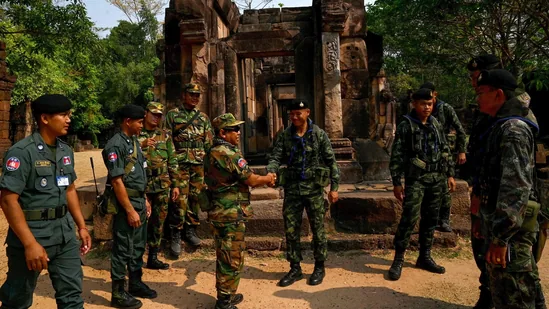
Thailand Cambodia conflict: The raged louder despite a claim made by US President Donald Trump that both countries had agreed to ceasefire. The fighting along the border was intensified as military operations were escalated.
Bombardments, airstrikes, and troop movements went on until the dawn, showing that the situation was still unstable. The return of hostilities made quite a stir in Southeast Asia, which has been the scene of the long-standing border dispute that sometimes resulted in armed clashes.
Thai prime minister Anutin Charnvirakul disapproved of the ceasefire announcement. He expressed that Thailand was not in a position to halt military action until Cambodia pulled back its troops and cleared the landmines from the areas of the dispute. His words demonstrated how far the two parties were from achieving a peaceful resolution.
Thailand Rejects Ceasefire: Prime Minister Responds to US Announcement
Thailand Cambodia conflict
Prime Minister Anutin Charnvirakul disclosed to President Trump that a ceasefire was out of the question given the current situation. He firmly believed that Cambodia should be the one to prove first that its forces had vacated the disputed area and that landmines had been removed.
As per Anutin’s version, the Thai army would be taking the field until a point when they felt totally safe with their land and people. He declared this stance openly via social media. His communication made it clear that Thailand regarded the continuation of military action as a requirement for their national security.
The prime minister urged that previous statements from Washington were not representative of Thailand’s official position. He suggested that there was still no mutual understanding between the two countries regarding ceasefire terms.
Shelling and Airstrikes Continue Overnight
There were continuous attacks despite the ongoing diplomatic talks. Several areas along the border were shelled, and Thai troops were reported to be climbing the hills to take control of the top. The military experts said that the places in question usually decide the direction of border conflicts as they provide the advantage of seeing and controlling the area.
Both the countries confirmed that the border skirmishes went on. Thailand informed that its forces were taking defensive actions. Cambodia blamed Thailand for the continuation of airstrikes, which targeted numerous places in their territory.
Initial reports indicate that at least 21 people have lost their lives since the resumption of the fight. Close to 700,000 civilians from both sides have been relocated to safe places. The humanitarian groups have cautioned that if the fighting goes on, it will lead to more people being displaced and will put a strain on the resources of the provinces that are suffering from this crisis.
US President Trump Claims Both Sides Agreed to Ceasefire
Thailand Cambodia Conflict and Diplomatic Intervention Attempts
According to President Trump, he had phone conversations with both the leaders on the preceding night. He took it to the internet and wrote that the two countries – Thailand and Cambodia had agreed to a ceasefire and also to abide by the conditions they had accepted in October. To be more specific about his role, he added that he was the ‘decisive factor’, and he was convinced that both the countries were looking for peace.
At the beginning of the week, Trump commented that he could bring the fighting to an end through his calls to the two prime ministers. Yet the fact that the military activities were going on right after his statement indicates that the diplomats have not solved the root causes of the crisis.
Meanwhile, Thailand marked the escalation of the conflict by declaring its non-aggression. The Thai government claimed that before the announcement of the ceasefire can be trusted, Cambodia must first withdraw its forces from the areas concerned.
Cambodia Reports Fresh Airstrikes by Thailand
Cambodia’s defense ministry reported that two Thai F-16 fighter jets attacked its territory. It specified that on December 13, 2025, seven bombs were dropped on the border areas. The ministry also mentioned that the Thai military had not stopped its offensive operations.
Later on, the Thai military also confirmed the continuation of the fight. Neither of the sides hinted that air operations would come to a halt, despite Trump’s ceasefire declaration.
The establishment of ceasefire agreements was challenged.
The distance between the political statements and the actual events on the ground was pointed to by the observers as one of the factors that made it hard for the de-escalation to take place. The independent monitors have asked for access to the border areas, but their movement has been restricted due to safety issues.
Long-Standing Border Dispute Behind the Renewed Fighting
Historical Background of the Thailand Cambodia Conflict
The conflict between the Thailand and Cambodia did not happen abruptly. Those two countries have been disputing their 800km common border for more than a hundred years. The original border was delineated in 1907 by the French colonial authorities when Cambodia was their colony.
Since that time, the disputes have centered around the reinterpretation of the old maps, ownership of temples, and control over the forested border regions. The numerous negotiations and agreements only resulted in borderline clarifications, but disagreements still remained.
The conflict turned violent in July 2025. Cambodia fired a volley of rockets into Thailand. In return, Thailand hit airstrikes that brought death to some people and injured the property. The battle spattered subsequent weeks and across multiple provinces.
In October, Trump together with Malaysian Prime Minister Anwar Ibrahim helped to negotiate the ceasefire. The pact was characterized as “immediate and unconditional.” However, the two sides later blamed each other for breaches of the agreement.
Accusions of Ceasefire Violations Fuel Tensions
Thailand released what it termed as proof of Cambodian soldiers planting new landmines. According to the Thai officials, the mines caused grievous wounds to a number of their soldiers. Meanwhile, Cambodia refused the charges. It claimed that the landmines were leftovers from the civil war back in the 1980s.
These opposing assertions have deepened the mistrust. Each of the countries has accused the other of not abiding by the commitments made in the October agreement. Although diplomatic channels have been open, neither of the parties has made sufficient concessions to lower the intensity of the conflict.
The conflict deteriorated when Thailand responded to the border clash that resulted in the injury of two soldiers with new airstrikes. Following this, Cambodia fired rockets targeting Thai positions. Both sides’ officials confirmed that fighting occurred in at least six provinces on each side.
Humanitarian Impact: Thousands Displaced Across Border Provinces
Civilian Disruption Amid the Thailand Cambodia Conflict
The renewed conflict has brought severe consequences for the civilian populations. Almost 700,000 people have been relocated since the fight has escalated. The local authorities of both countries moved the residents of villages near the military zones to the shelters.
These evacuations were intended to save lives, but they interfered with everyday life. Schools were closed, agricultural activities came to a halt, and transport routes were restricted. The humanitarian workers stated that if the displacement is prolonged, it could have a negative effect on the people’s access to food, water, and healthcare.
Medical teams in several provinces have reported that they have been treating patients who are
injured due to the conflict. They have also made preparations for an increase in such cases if the fighting
continues.
Border Regions Witness Escalating Military Movements
Thai forces moved into several high-ground areas. Military experts say that control over these views
gives the holder significant strategic advantages.
Reports suggested that artillery exchanges occurred across a wide stretch of the border.
Observer warned that the risk of unplanned military actions could cause a higher death toll. They urged that negotiations should be resumed to avoid a bigger escalation.
International organizations appealed to the two governments to put the safety of the civilians above all else. They also suggested that opening of the channels for the ease of the humanitarian works should be done.
International Reactions to the Renewed Conflict
Global Concerns Over the Thailand Cambodia Conflict
The community of nations responded in alarm to the latest flare-up. A number of Southeast Asian governments urged the parties concerned to calm down and return to the discussions. They stressed the significance of stability in the region.
The US re-affirmed its readiness to facilitate peaceful talks. Nevertheless, Thailand cautioned Washington against mixing up the issue of the conflict with that of trade. There has been some tension between the two nations because of a few incidents related to tariffs.
Other nations preferred to stay out of it directly. They exhorted the parties to abide by the prior accords and lessen their military activities. The experts pointed out that regional collaboration would be the key to lasting peace.
Timeline of Recent Events in the Thailand Cambodia Conflict
Understanding the quick escalation can be helped by a chronological summary of the latest developments:
Monday: The conflict erupted once more with border skirmishes.
Tuesday: There was a sharp increase in the use of artillery.
Wednesday: Evacuations were reported in several provinces.
Thursday: Both sides confirmed that their planes had bombed the other.
Friday: After his talks with the leaders, Trump made known the agreement on a ceasefire.
Saturday: The denial of the ceasefire by Thailand. Fighting went on with the new airstrikes and shelling.
This order of events revealed that the violence didn’t get any lighter, despite the embassy’s attempts to intervene.
Why the Ceasefire Announcement Failed Immediately
The experts on the matter pointed out several reasons for the failure:
Disagreement on the exact conditions for withdrawal
According to Thai side, Cambodian troops should be the first to withdraw.
Questions about who was responsible for the landmines
Each party accused the other of putting new landmines.
Distrust of the previous ceasefire violations
The October agreement was not fully executed.
Continuous competition for border strategies
Control of the higher ground was still a major goal.
Participation problems between politicians and army units
The statements did not reflect the reality on the ground.
All of these factors combined to make an instant ceasefire hard to come by.
Political Context and Leadership Statements
The head of Thailand stated that national security was the main factor that determined the army’s actions. Cambodia also shared the view of leading the army with the mission of protecting the homeland. Both sides assured that they were on the defensive.
Trump’s mediation effort only gained momentary attention but did not bring about changes in the military situation. There was still a big gap between political talks and what was really happening on the battlefield.
Regional experts believed that agreeing to a truce would take more detailed talks, along with confirmable steps from both sides.
Historical Overview of the Thailand Cambodia Conflict
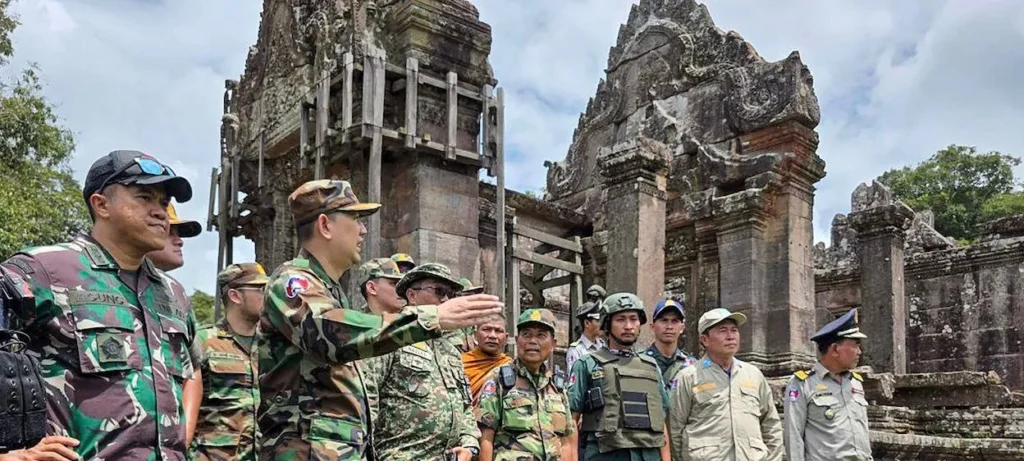
Roots of the Thailand Cambodia Conflict and Territorial Disputes
The disagreement goes back to the times when the border was being drawn between the colonized territories. The 1907 border made by France caused the overlapping of the claims. For the most part, over the years, people have been arguing about maps, temples, and forested areas.
One of the places that the Preah Vihear Temple was just an example. Deciding some of the issues by international courts left others still uncertain. The border markers, nature, and history have all been parts of the arguments.
The confrontations have been happening from time to time. While diplomatic agreements have achieved some de-escalation, unresolved issues have been the root of the conflict.
Latest Assessment: Escalation Likely Without New Talks
Thailand Cambodia conflict According to military experts, the escalation of the conflict could not be prevented without renewed talks between the two sides. They also added that mistrust and strategic objectives made the situation very unstable.
Without clear mechanisms for checking, announcements of ceasefire would not have the immediate effect that the experts had envisaged. They suggested international supervision, measures for building trust, and assistance for the needy as ways forward.
Officials in both countries have said that they are willing to talk. But neither side has given any indication that they would stop their operations.
Conclusion: Thailand Cambodia Conflict Requires Sustained Diplomacy
Thailand Cambodia conflict Despite the international attention and the US president’s ceasefire announcement, the conflict between Thailand and Cambodia persisted. The latest developments were shaped by military operations, evacuations, and political disagreements.
Renewed hostilities between the two were blamed on the long-term border disputes, the competing territorial claims, and the mistrust of each other. Analysts argued that a lasting truce would need coordinated steps, verifiable actions, and consistent communication.
The impact on the people remained quite severe. Hundred thousands of innocent people were caught up in the displacement and the uncertainty of the situation.
The resolution to the conflict depended on the continuation of the diplomatic efforts and the willingness of both sides to lessen the fighting.
