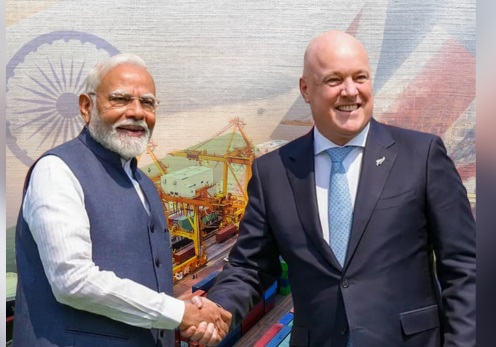
A Major Breakthrough in India–New Zealand Trade Relations
New Zealand India Free Trade Agreement: In a landmark development, India and New Zealand have formally concluded negotiations on a comprehensive Free Trade Agreement (FTA) designed to significantly expand bilateral economic cooperation over the next five years. The announcement, made simultaneously by both governments, marks the culmination of months of accelerated diplomacy and trade consultations.
Under the proposed agreement, 95% of New Zealand’s exports to India will either see reduced tariffs or complete tariff elimination, with more than half of those products becoming duty-free from day one. In return, all Indian goods will gain duty-free access to the New Zealand market. This strategic trade alignment is expected to double the current trade volume, which stood at approximately $1.81 billion in 2024.
The pact also includes commitments from New Zealand to invest $20 billion in India over the next fifteen years, reinforcing confidence in India’s growing role as a global economic powerhouse.
New Zealand India Free Trade Agreement: Why the FTA Matters Now
The New Zealand India Free Trade Agreement arrives at a critical moment when India is intensifying efforts to diversify its export markets. With global geopolitical shifts reshaping trade flows, both nations see unique opportunities for growth.
For New Zealand, India represents:
- The world’s most populous market
- A rapidly expanding consumer base
- One of the fastest-growing major economies
For India, New Zealand offers:
- Access to advanced agri-tech
- A high-value export market for pharmaceuticals and IT services
- An important Indo-Pacific partner
This shared vision has produced an agreement that both sides have called “historic, ambitious, and future-focused.”
- Related news:
Trump C5 Grouping: Inside the Buzz Around a Possible New Power Bloc
Tariff Reductions Under the New Zealand India Free Trade Agreement
A key highlight of the FTA is the substantial removal and reduction of tariffs across multiple categories. According to the New Zealand government, 95% of its exports to India will see improved market access.
Day-One Duty-Free Products (New Zealand Exports to India)
More than half of New Zealand exports will become duty-free as soon as the agreement is implemented. These include:
- Forestry products
- Wool and fiber
- Certain industrial goods
- Select agricultural equipment
Reduced Tariffs on Additional Goods
Goods that will receive reduced tariffs include:
- Meat products
- Horticulture produce
- High-value manufactured items
Although New Zealand had pushed strongly for dairy access, India firmly excluded that sector to safeguard domestic farmers.
India’s Duty-Free Access to New Zealand
India secured 100% duty-free access for all its goods, creating major opportunities for:
- Pharmaceuticals
- Industrial machinery
- Textiles
- Auto components
- Electronics
- Processed foods
This ensures Indian exporters gain a competitive edge in the New Zealand market.
Why Dairy Is Excluded from the New Zealand India Free Trade Agreement
One of the most significant carve-outs in the deal is the exclusion of dairy products. New Zealand is a global dairy leader, while India is the world’s largest milk producer with millions of small-scale farmers depending on the sector.
To shield domestic industries, India excluded:
- Milk
- Cheese
- Butter
- Cream
- Yoghurt
- Whey
- Caseins
This protectionist stance aligns with India’s long-standing approach in other FTAs as well. Beyond dairy, the FTA also excludes:
- Coffee
- Onions
- Sugar
- Spices
- Rubber
- Edible oils
These exclusions reflect India’s intention to prioritize local producers and maintain rural economic stability.
Political Commitments Behind the New Zealand India Free Trade Agreement
The FTA fulfills a major 2022 election pledge by New Zealand’s National Party, which had promised it would pursue a comprehensive trade agreement with India if elected.
Prime Minister Christopher Luxon described the conclusion of talks as a “wide-ranging and significant” achievement, noting that India’s scale and growth trajectory offer exceptional opportunities for New Zealand exporters.
He added:
“India is the world’s most populous country and is the fastest-growing big economy, and that creates opportunities for jobs for Kiwis, exports and growth.”
On the Indian side, Prime Minister Narendra Modi welcomed the rapid progress and called the deal a symbol of “strong political will and shared ambition.”
Nine Months of Negotiations: How the Agreement Came Together
One of the most remarkable aspects of the New Zealand India Free Trade Agreement is the speed of negotiations. While many FTAs take years—sometimes more than a decade—to finalize, this deal was completed in just nine months.
Modi described this rapid timeline as:
“A historic milestone that reflects our shared commitment to deepening economic ties.”
Several factors enabled the accelerated pace:
1. Rising Indo-Pacific Cooperation
Both countries have become increasingly aligned strategically in the Indo-Pacific, particularly on issues related to:
- Economic stability
- Regional security
- Supply chain diversification
2. India’s Push for New Trade Partnerships
After U.S. tariffs on Indian goods increased to 50%, India began fast-tracking new trade agreements to reduce dependence on a few markets.
3. New Zealand’s Diversification Goals
New Zealand is working to expand beyond traditional partners like:
- China
- Australia
- United States
India’s massive market offers long-term potential.
4. Improved Diplomatic Engagement
High-level visits, ministerial dialogues, and business delegations helped maintain momentum throughout the negotiation process.
What Bilateral Trade Looks Like Today
Despite strong diplomatic ties, India and New Zealand have historically maintained modest levels of trade.
Current Two-Way Trade (2024)
$1.81 billion
New Zealand’s Main Exports to India
- Logs and wood
- Wool
- Fruits
- Machinery
- Certain specialties in food and beverage
India’s Main Exports to New Zealand
- Pharmaceuticals
- Textiles
- Gems and jewelry
- Engineering goods
- Industrial chemicals
Given India’s total trade volume exceeded $1 trillion last financial year, there is enormous scope for expansion.
The FTA seeks to correct this imbalance and unlock unrealized potential.
What the New Zealand India Free Trade Agreement Means for India
India stands to benefit in multiple ways from the FTA. Key advantages include:
1. Greater Market Access for Indian Pharmaceuticals
India is one of the world’s largest drug exporters, and duty-free access will strengthen India’s presence in New Zealand’s healthcare sector.
2. Boost to Textiles and Garments
Indian textiles, already competitive globally, will gain more visibility and pricing advantage.
3. Improved Prospects for Auto and Engineering Goods
Indian manufacturers in automotive components, industrial machinery, and electronics will find New Zealand a lucrative destination.
4. Increased Opportunities for IT and Services
Although goods dominate trade, the FTA is expected to encourage stronger digital and services cooperation between the two countries.
5. Long-Term Investment Flow
The $20 billion investment commitment is likely to support:
- Startups
- Renewable energy
- Infrastructure
- Technology partnerships
What the New Zealand India Free Trade Agreement Means for New Zealand
New Zealand exporters view the FTA as a major breakthrough, especially after years of limited access to India’s large market due to high tariffs.
Key benefits include:
1. Enhanced Market Access for Forestry Products
India is a major importer of timber and wood, making the sector a crucial beneficiary.
2. Growth Potential in Agri-Tech
New Zealand’s expertise in agricultural technology aligns with India’s modernization goals.
3. Investor Confidence in India’s Economy
With India expanding rapidly and implementing business-friendly reforms, New Zealand investors gain a stable environment for long-term growth.
4. Opportunities in Renewable Energy
New Zealand companies will explore partnerships in:
- Green hydrogen
- Solar
- Wind energy
- Waste-to-energy technologies
5. Expansion of Education Partnerships
New Zealand’s well-developed education sector may see increased interest from Indian students and institutions.
Concerns Raised by New Zealand First Party
Despite the momentum, political challenges remain in New Zealand. The FTA requires parliamentary approval, and New Zealand First, a coalition partner, has openly opposed it.
Party leader Winston Peters said the deal:
“Gives too much away, especially on immigration, and does not get enough in return for New Zealanders, including on dairy.”
New Zealand First holds eight seats, and while the coalition government has a total of 67 out of 123 seats, the Nationals themselves control only 48. Therefore, passing the agreement will require support from coalition partners.
This introduces an element of uncertainty ahead of the signing scheduled for the first half of 2026.
The Road to 2026: What Happens Next?
Although negotiations are complete, several steps remain before the FTA becomes operational:
1. Legal Scrubbing and Document Finalization
Both sides must perform technical reviews to finalize legal language.
2. Parliamentary Approval in New Zealand
This is the key hurdle due to internal coalition disagreements.
3. Cabinet Approval in India
India’s approval process is typically faster.
4. Signing Ceremony in 2026
The agreement is expected to be formally signed in the first half of 2026.
5. Implementation Phase
Both nations will begin implementing tariff changes and investment frameworks.
If all conditions align, the FTA will reshape India–New Zealand trade dynamics for years to come.
Impact on Global Trade: India’s New Strategy
The New Zealand India Free Trade Agreement is part of a broader shift in India’s trade policy.
FTAs India Has Concluded This Year
- Oman (Economic Partnership Agreement)
- United Kingdom (Comprehensive FTA)
- New Zealand (Current agreement)
India is also negotiating with:
- European Union
- Gulf Cooperation Council
- Canada
- Australia (final stage of CECA)
This reflects India’s strategy to strengthen:
- Supply chain resilience
- Export diversification
- Strategic trade alliances
How the New Zealand India Free Trade Agreement Helps Indian Exporters
Indian businesses can expect numerous advantages once the FTA takes effect:
Less Competitive Pressure in Sensitive Sectors
India successfully protected its:
- Dairy sector
- Agricultural commodities
- Plantation crops
Zero Tariffs in a Developed Market
Duty-free access boosts India’s competitiveness immediately.
Increased Investor Confidence
New Zealand’s commitment sets a positive precedent for other countries.
Boost to MSMEs and Startups
With reduced trade barriers, smaller businesses can explore new markets.
Economic Forecast: Can Bilateral Trade Really Double?
Experts believe the target is realistic due to:
- Rapid tariff reductions
- Growing complementarities
- Expanding middle-class consumer markets
- Rising demand for industrial goods
If current projections hold, bilateral trade may reach:
$3.5 to $4 billion by 2030
This would align with the goals outlined in the FTA.
How Industries in Both Nations Will Change
Sectors That Benefit in India
- Pharma
- Engineering goods
- Textiles
- Auto components
- IT services
Sectors That Benefit in New Zealand
- Forestry
- Agri-tech
- Industrial machinery
- Renewable energy
- Education
Sectors Facing Challenges
- New Zealand dairy (due to exclusion)
- Indian spices and agricultural products (due to exclusion)
Business Community Reactions
The agreement has received overwhelmingly positive responses from industry groups in both countries.
Indian Industry Groups
Organizations like FICCI and CII welcomed the FTA, highlighting:
- Opportunities for exporting pharmaceuticals
- Potential for startup collaboration
- Increased investment flows
New Zealand Exporters
Export NZ and the New Zealand International Business Forum described the deal as:
“A once-in-a-generation opportunity.”
However, dairy producers expressed disappointment at their exclusion.
Public Sentiment and Market Expectations
Public reactions in both nations have been largely optimistic:
- New Zealand businesses expect faster market access
- Indian exporters see renewed confidence
- Indian consumers may gain access to higher-quality goods
- Stock markets may respond positively once the deal is signed
A Transformative Step for India–New Zealand Relations
The New Zealand India Free Trade Agreement marks a new chapter in bilateral cooperation. It promises:
- Stronger economic partnerships
- Diversified export markets
- Increased investments
- Greater geopolitical alignment
- New opportunities for businesses and workers
Despite political hurdles in New Zealand, the agreement holds the potential to reshape trade relations in the Indo-Pacific for decades to come.
As both nations prepare for the formal signing in 2026, the global economic community will closely watch how this ambitious agreement unfolds.
