
New US visa rule: requiring H-1B workers, applicants, and H-4 dependents to make their social media accounts public has triggered widespread anxiety across Indian immigrant communities. The mandate, which officially takes effect on December 15, expands the already strict vetting framework and allows consular officers to examine an applicant’s online activity before approving or renewing their visa.
The timing, the sudden changes, and the large-scale disruption of visa appointments across India have combined to create a wave of uncertainty for thousands of families. For many Indians who rely on uninterrupted visa status to maintain jobs, mortgages, education plans, and travel schedules, the new policy has become a serious concern almost overnight.
With Indians accounting for more than 70% of all H-1B approvals and nearly 90% of H-4 EAD holders, the impact is disproportionately heavy on this demographic. New US visa rule Immigration lawyers, employers, and applicants are describing the situation as one that has already disrupted travel, career timelines, and family reunions—months before the full effect of the rule is even visible.
Consulates Cancel Appointments as New US Visa Rule Takes Effect
The most immediate fallout from the US visa rule has been the sudden cancellation of visa interview appointments at US consulates across India. Reports indicate that appointments scheduled at the Hyderabad, Chennai, and Delhi consulates for December have been pushed as far as March 2026.
The abrupt changes have blindsided applicants who were preparing to travel or had already traveled to India for their scheduled interview dates. New US visa rule Many new hires set to join US companies in January have now been left uncertain about their employment timelines. Families who came to India for weddings, baby arrivals, or to drop off children are now stranded.
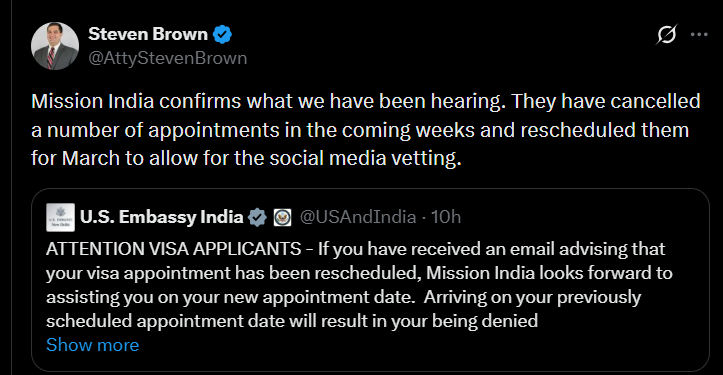
Immigration attorney Steven Brown confirmed that the cancellations were widespread. “Mission India has cancelled a number of appointments in the coming weeks and rescheduled them for March to allow for the social media vetting,” he said.
For thousands of applicants, the rescheduling has created a two-year delay window, which is unprecedented for high-skilled visa categories.
US Visa Rule Forces Social Media Profiles to Be Made Public
A major element of concern is the US government’s requirement that all H-1B and H-4 applicants must make their social media profiles public. Platforms such as:
- X (formerly Twitter)
- YouTube
will be scanned to verify identity, check for security or fraud risks, and ensure that applicants’ posts align with visa declarations.
This expansion of online vetting already exists for student and exchange visitor visas, but applying it to H-1B and H-4 categories marks a significant escalation.
The US State Department defended the rule in its guidance, stating:
“Every visa adjudication is a national security decision.”
The agency noted that public social media review helps identify individuals who may “intend to harm Americans or US interests.” The statement also emphasized that a US visa is a privilege, not a right.
Advertisement

Tech Workers, Lawyers, and Employers Raise Concerns
New US visa rule Indian tech workers—who form the majority of America’s H-1B workforce—have reacted with concern. Immigration attorneys report that even ordinary posts, such as political memes, comments on global events, or mismatched resume information on LinkedIn, could result in additional scrutiny.
US employers are now advising workers to take steps such as:
- auditing their social media pages
- removing controversial or ambiguous content
- maintaining consistency between resumes, petitions, and LinkedIn profiles
- avoiding political commentary altogether
- ensuring no conflicting employment-related posts
- using professional emails only
With tech companies under scrutiny over foreign worker sponsorship, the new rule adds another layer of fear among employees already navigating layoffs, skill audits, and tight visa timelines.
High Dependence of Indians on H-1B and H-4 Visas Increases Anxiety
The impact of the US visa rule feels amplified because Indians form the largest share of applicants. Decades of US employment immigration trends have resulted in a system where Indian nationals dominate H-1B approvals.
Key Statistics
- Over 70% of all H-1B approvals go to Indian applicants.
- Nearly 90% of all H-4 EAD holders are spouses of Indian H-1B workers.
- Many families have been waiting 10–15 years for green cards, making uninterrupted visa renewals essential.
For these workers and families, travel home to India often revolves around available visa slots. A sudden cancellation of December 2024 appointments means they now face:
- job disruptions
- visa lapses
- family separation
- uncertainty in school schedules for children
- the risk of losing employer sponsorship
The emotional pressure has risen significantly as thousands try to understand how to comply with the new requirements.
US Embassy in India Issues Advisory
Following the confusion caused by widespread appointment cancellations, the US Embassy in India issued a public advisory urging applicants not to appear on their old interview dates.
The advisory clarified:
“If you have received an email advising that your visa appointment has been rescheduled, Mission India looks forward to assisting you on your new appointment date. Arriving on your previously scheduled appointment date will result in your being denied admittance.”
This guidance was intended to prevent crowding at consulates and reduce confusion, but it also confirmed that the cancellations were linked directly to procedural changes connected to the new visa policy.
Applicants fear increased delays under the new US visa rule.
Visa applicants who were already used to long wait times now fear significantly longer processing periods because of the new rule. Social media reviews, identity verification checks, and additional administrative processing could slow down the workflow further.
Applicants now anticipate:
- longer clearance times
- more 221(g) administrative processing cases
- higher chances of in-depth questioning
- requests for additional documentation
- cross-checking between LinkedIn and USCIS filings
With the implementation of the rule, even minor discrepancies in employment history, education timelines, or personal information shared online could trigger delays.
Impact on New US visa rule H-1B Hires and US Companies
US companies—especially tech firms—depend heavily on Indian workers to fill specialized roles. The appointment cancellations and uncertainty have placed HR departments under intense pressure.
Many companies now face:
- postponed start dates
- project delays
- the need for remote onboarding arrangements
- contract renegotiations
- the risk of losing highly-skilled talent
Some firms are even reconsidering travel approvals for employees until the situation stabilizes.
Families Separated and Travel Plans Disrupted
Perhaps the hardest-hit group under the US visa rule is families. Many Indian immigrants plan travel home around visa appointment slots, school holidays, festival seasons, and childbirth events.
With appointments pushed to 2026, several applicants now find themselves:
- stuck in India with children abroad
- unable to return to US-based jobs
- separated from spouses
- facing rental or mortgage issues in the US
- uncertain about school admission timelines
Immigration legal experts say that the wave of cancellations has already created a humanitarian impact that policymakers might not have anticipated.
Why the New US visa rule Was Introduced
While officials emphasize national security, immigration experts believe the rule aligns with:
- increased digital surveillance policies
- the rise of global security risks
- the US government’s effort to verify identity authenticity
- higher scrutiny towards non-immigrant worker categories
US immigration has gradually tightened over the years, but the requirement for public social media profiles marks one of the most intrusive measures yet.
What New US visa rule Applicants Must Now Do to Comply
Although the policy is new, immigration attorneys recommend applicants follow these precautions:
1. Ensure Social Profiles Are Public
All listed social media fields must display readable content.
2. Maintain Professional Conduct Online
Avoid political posts, inflammatory remarks, or unverified claims.
3. Remove Conflicting Information
Employment timelines and job titles on LinkedIn should match USCIS petitions.
4. Avoid Humor That Could Be Misinterpreted
Sarcasm or memes may be misread without context.
5. Update Profile Photos
Clear identity helps prevent confusion in background checks.
6. Avoid Posting About Immigration or Visa Challenges
Complaints or frustrations may be reviewed during vetting.
Concerns About Privacy and Digital Freedom
New US visa rule Civil rights advocates argue that the requirement compromises privacy and may suppress free speech. Many fear that people will now self-censor online to avoid jeopardizing their future or current visa status.
Digital rights groups express concerns that:
- public posting requirements expose individuals to harassment
- applicants may feel compelled to delete years of personal content
- the policy disproportionately affects certain nationalities
- the standard for acceptable content remains unclear
However, officials maintain that the rule strengthens national security.
Immigration Attorneys Expect More Changes Ahead
New US visa rule Experts believe that the US may continue tightening immigration checks, especially digital ones. They caution that applicants must:
- stay informed about future updates
- consult lawyers before making travel plans
- prepare for administrative processing risks
- ensure flawless consistency across online platforms
Attorneys also warn that over-cleaning one’s social media—such as deleting entire accounts—may itself raise suspicions.
A Sudden Change With Long-Term Impact New US visa rule
The new US visa rule has already caused a significant ripple effect across India. The combination of sudden appointment cancellations, new compliance guidelines, and increased scrutiny has created a climate of fear among thousands of skilled workers and their families.
As the policy takes effect from December 15, both applicants and employers are bracing for longer delays, stricter reviews, and deeper digital background checks.
For now, the only certainty is that the US visa process has entered a new era of online transparency—one where every public post may influence the outcome of a visa application.
