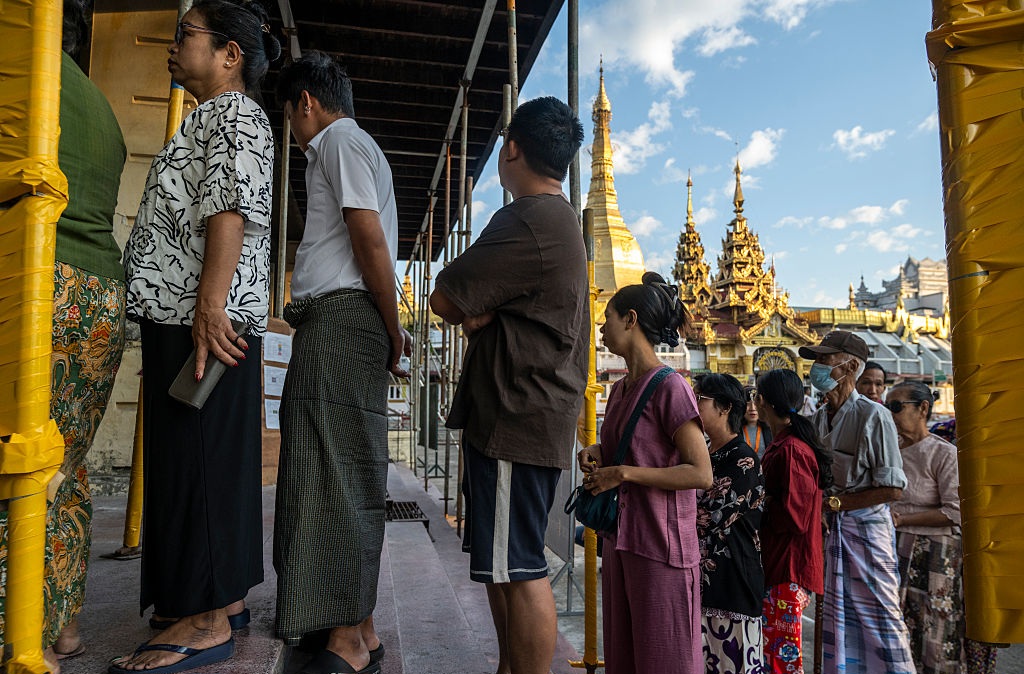
The Myanmar election has begun under extraordinary circumstances, with the country engulfed in a prolonged civil war and political unrest. Despite widespread criticism from the international community, Myanmar’s ruling junta is pushing ahead with an electoral process that many observers say lacks legitimacy, transparency, and fairness. As polling stations opened on Sunday morning, a sense of uncertainty overshadowed the event, raising questions about how meaningful the vote will be for a nation fractured by conflict.
Although the junta promotes the election as a fresh political beginning, critics argue that it is a strategic move aimed at legitimising military rule. Many political parties, especially those opposed to the junta, were barred or dissolved before the vote. Consequently, Myanmar’s political environment today looks very different from what it was before the 2021 military coup that overthrew Aung San Suu Kyi’s civilian government.
A Tense Political Climate Surrounds the Myanmar Election
The Myanmar election is unfolding in an environment shaped by violence, displacement, and deep political divisions. The civil war that erupted after the coup continues to spread, with ethnic armed organisations and resistance groups fighting for control across several regions. For many citizens, daily life is unstable, and the idea of participating in an election holds little promise of genuine democratic change.
Even though polling stations opened as early as 6 a.m., voter turnout began slowly. The streets of Yangon, Mandalay, and other large cities showed only small groups of voters heading to cast their ballots. Local reports indicated a subdued atmosphere — a stark contrast to the energetic and hopeful scenes seen during previous elections, particularly the one held in 2020.
The junta’s strict control over information, combined with widespread fear among residents, has contributed to the lack of enthusiasm. People who opposed the coup often chose not to participate in the polls, believing the outcome is predetermined.
Junta Chief Min Aung Hlaing Casts Vote but Downplays Presidential Role

Junta chief Min Aung Hlaing, who led the military takeover in 2021, appeared early at a polling booth in Naypyitaw. Wearing civilian attire, he cast his vote under heavy security. State-linked media released several images of him smiling and showing his ink-marked finger — a standard procedure to prevent multiple voting.
Although he is widely believed to harbour ambitions of becoming the next president, he insisted otherwise when speaking to reporters. He stated that he does not lead any political party and will not directly pursue the presidency. Instead, he emphasised that the future parliament would follow constitutional procedures to select the president. However, analysts remain unconvinced, arguing that the election structure appears designed to favour the military establishment.
These remarks may reflect an attempt to portray a neutral, democratic process. Yet, given that the junta dissolved major opposition parties, including Suu Kyi’s National League for Democracy (NLD), critics say such claims hold little weight.
Political Parties in the Myanmar Election: A Landscape Dominated by the Military
The Myanmar election features a drastically reduced number of political competitors. The National League for Democracy, which won the 2020 election by a landslide, no longer exists as a legally recognised political entity. Aung San Suu Kyi herself remains in detention, serving multiple sentences issued after the coup.
With opposition voices silenced, the military-backed Union Solidarity and Development Party (USDP) has emerged as the dominant participant. Led by retired generals, the USDP is contesting a substantial portion of the seats and is widely expected to secure a favourable outcome due to the limited competition.
Experts argue that the junta’s dominance over the political structure leaves little room for genuine electoral choice. According to Lalita Hanwong, a scholar of Myanmar politics, the election appears engineered to maintain military control under the appearance of civilian governance. She emphasises that even with new political parties on the ballot, none hold the influence or credibility necessary to challenge the military’s power.
How Violence and Conflict Are Shaping the Myanmar Election
The civil war has forced millions of people from their homes, disrupted livelihoods, and destroyed infrastructure in many regions. As a result, the conduct of the Myanmar election has become extremely challenging. Only 265 out of Myanmar’s 330 townships will participate in the vote. The junta does not have full control in many areas, and some zones are actively experiencing conflict as voting takes place.
To manage the situation, the junta has scheduled the election in multiple phases, with additional rounds planned for January 11 and January 25. However, critics argue that spreading the election over weeks gives authorities more room to influence results, especially in conflict-prone areas.
The United Nations has warned that the election is occurring under conditions of violence and repression. UN human rights chief Volker Turk described the atmosphere as unsafe for free voting and raised concerns about the lack of transparency and accountability.
A Lack of Enthusiasm Compared to Previous Elections
During earlier elections, citizens eagerly engaged in political activities. Streets filled with party flags, volunteers campaigned openly, and people felt hopeful about shaping their country’s future. In contrast, the current Myanmar election has been marked by silence. Campaigning is minimal, public gatherings are limited, and people show little excitement.
Several factors contribute to this muted environment:
Fear of violence
Many residents avoid political gatherings to reduce the risk of military confrontation.
Distrust in the electoral process
With major opposition parties banned and leaders imprisoned, people feel the election cannot offer meaningful change.
Economic hardships
The country’s economy has deteriorated significantly since the coup, leaving people more focused on survival than politics.
Constant instability
Daily news of clashes, arrests, and military operations overshadows the idea of voting.
For many citizens, participating in the election feels like an endorsement of a system they do not trust.
Electronic Voting Machines Introduced for the First Time
The junta has introduced over 50,000 electronic voting machines (EVMs) for the first time in Myanmar’s history. Officials claim that these machines will make the process faster and eliminate the risk of fraud. However, opposition groups and election experts remain sceptical, arguing that the junta controls every aspect of the voting system and could manipulate results.
In a country where electricity is unstable and digital infrastructure is weak, the sudden shift to electronic voting has raised concerns about accuracy, transparency, and security.
International Reaction: Limited Recognition Expected
The Myanmar election has attracted foreign delegations from countries including Russia, China, Belarus, Cambodia, Vietnam, Kazakhstan, Nicaragua, and India. While their presence offers some level of international observation, the list mainly comprises nations that maintain close ties with Myanmar’s military administration.
Western governments, the United Nations, and various human rights organisations have dismissed the election as illegitimate. They argue that a vote held under military rule, without political freedoms and with opposition leaders in jail, cannot reflect the will of the people.
Despite hoping for stability and support, the junta is unlikely to receive broad international recognition. Any government formed through this election will face significant challenges in gaining legitimacy abroad.
Aung San Suu Kyi’s Absence Still Shapes the Election
Although she remains out of sight, Aung San Suu Kyi’s influence looms large. Her removal from politics has deeply affected public sentiment. Many citizens who supported her in previous elections have boycotted the polls altogether.
Her party, the National League for Democracy, once represented Myanmar’s strongest democratic movement. Its dissolution eliminates a central pillar of civilian representation. Even though the junta maintains that legal processes justified the party’s end, many observers view it as a political decision designed to eliminate opposition
The Military’s Vision for Myanmar After the Election
The junta insists that the Myanmar election will produce a government capable of restoring stability and guiding the country forward. Officials claim they seek to transition to a controlled civilian administration similar to the quasi-democratic government formed after the 2010 election.
Zaw Min Tun, a spokesperson for the junta, has highlighted that political stability and a “better future” are achievable through this election. However, citizens, activists, and analysts hold a very different view.
Many argue that stability cannot be achieved while military operations continue, civilians remain displaced, and political freedoms are restricted. Without meaningful reforms, they say the election is merely a symbolic gesture.
Will the Myanmar Election Change the Country’s Future?
Even though the voting process has begun, the trajectory of Myanmar’s political future remains uncertain. The civil war is far from over, and resistance forces continue to grow in strength across several regions. Meanwhile, international pressure against the junta is mounting.
Several key questions remain unanswered:
1. Can an election held under military rule truly reflect public choice?
Critics believe the answer is no, given the absence of the most popular political party and the restrictive environment.
2. What will happen after results are announced?
The junta has not yet declared when counting will begin or when results will be released, adding further uncertainty.
3. Will conflict intensify after the election?
Some analysts warn that the vote may provoke more unrest, especially in areas where resistance groups hold power.
4. Can international diplomacy influence Myanmar’s future?
While neighbouring countries may accept the outcome, Western nations are expected to maintain pressure for a return to democratic rule.
As the Myanmar election progresses, the country stands at a critical crossroads.
Conclusion: A Nation Voting Under Unprecedented Circumstances
The Myanmar election, held amid civil war, repression, and economic hardship, reflects the deep fractures within the nation. The lack of open competition, detainment of key leaders, and ongoing conflict have cast doubt on the credibility of the process. Although the junta frames the election as a step toward stability, many citizens and international observers view it as an attempt to legitimise military control rather than restore democracy.
For Myanmar’s people, the struggle for freedom, peace, and political representation continues. Whether this election will bring stability or further deepen the crisis remains to be seen. What is clear, however, is that Myanmar’s path forward will depend not only on ballots cast but also on the broader political will to end violence and embrace genuine democratic reform.
