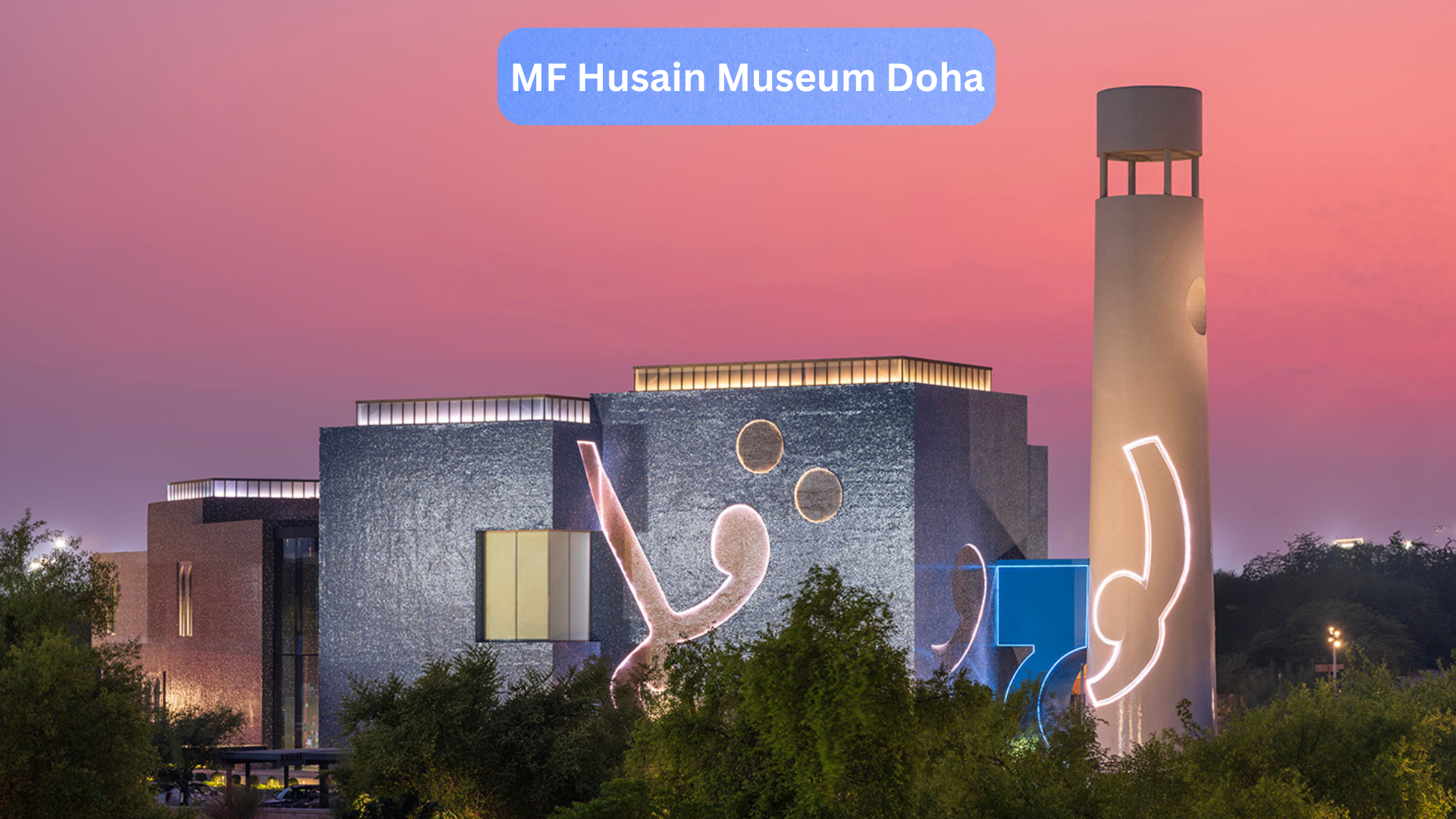
MF Husain Museum Doha: A new cultural landmark has opened in Doha, and it is attracting global attention for a historic reason. The world’s first museum dedicated entirely to MF Husain, one of India’s greatest modern artists, has officially begun welcoming visitors. The museum, named Lawh Wa Qalam (meaning “Art and Pen”), stands at the edge of Doha as a striking grey-blue structure that almost looks like a drawing rising from the desert skyline.
Its shimmering tiles reflect sunlight, creating geometric shadows that shift throughout the day. The building appears to lean forward gently, almost as if it is eager to share a story. For many people, that story represents the life, struggles, and remarkable artistic journey of Maqbool Fida Husain, the iconic painter who left an unforgettable mark on global art.
This museum is not just an exhibition space. It is a deeply personal tribute to an artist who spent his final years in Qatar and found a sense of peace, belonging, and creative rebirth there.
A Home for Husain’s Legacy
MF Husain Museum Doha was known for his nomadic lifestyle, fearless experimentation, and bold artistic language. Although he was born in India and shaped its modern art identity, his work traveled far beyond national borders. The museum in Doha recognises this global influence while also highlighting a lesser-known yet important chapter of his career — his productive late-life period in Qatar.
Spanning over 3,000 square metres, the museum houses more than 150 artworks and personal objects, including:
- Paintings
- Sculptures
- Tapestries
- Film material
- Photographs
- Sketches
- Diaries and notes
- Everyday objects like his old passport
Each piece helps visitors understand the immense range of Husain’s creativity. The museum does not follow a strict chronological order. Instead, it invites visitors to walk through his world the same way he saw it — full of movement, imagination, and emotional depth.
According to the museum’s curator, Noof Mohammed, Husain always wanted his museum to feel like home. He wished for visitors to sense his curiosity, humour, and reflective nature. This vision has shaped the interiors, creating an experience that feels intimate rather than formal.
The Artist Who Traveled Through Ideas
Very few artists have traveled as widely or imagined as boldly as MF Husain Museum Doha. His painted horses became symbols of strength, motion, and beauty. These horses — powerful, muscular, and free — are among the most recognisable works of contemporary Indian art. Many of them have been sold at auctions for millions of dollars.
Husain was often described as a wandering soul. His bohemian personality allowed him to experiment freely with styles and themes. One moment, he used Cubist-inspired modernism. The next, he explored Indian mythology, Mughal history, or contemporary social issues. His canvases often combined tradition and modernity with unusual ease.
This fusion of influences earned him the nickname “The Picasso of India.”
However, Husain’s life was not free from controversy. Some of his paintings depicting Hindu goddesses in the nude created strong backlash from right-wing groups in India. The accusations of obscenity pushed him into a self-imposed exile. During these turbulent years, Husain continued painting but longed for peace and artistic freedom.
Qatar became that safe space for him.
A New Life in Qatar
Husain received Qatari citizenship in 2010, and this period marked a turning point in his life. Away from the heated cultural debates of India, he entered a phase of quiet introspection and renewed creativity. He formed friendships with local artists, collaborated with institutions, and absorbed the cultural nuances of the Gulf.
Qatar-based artist Yousef Ahmad, who personally knew Husain during these years, recalls how deeply he connected with Arab civilisation. He was fascinated by its heritage, poetry, architecture, and history. Husain often expressed that he found peace and acceptance in Qatar, allowing him to explore new artistic directions without fear.
Some of his most ambitious late-life works were conceived here, making the location of the museum especially meaningful.
A Museum Inspired by a Single Husain Sketch
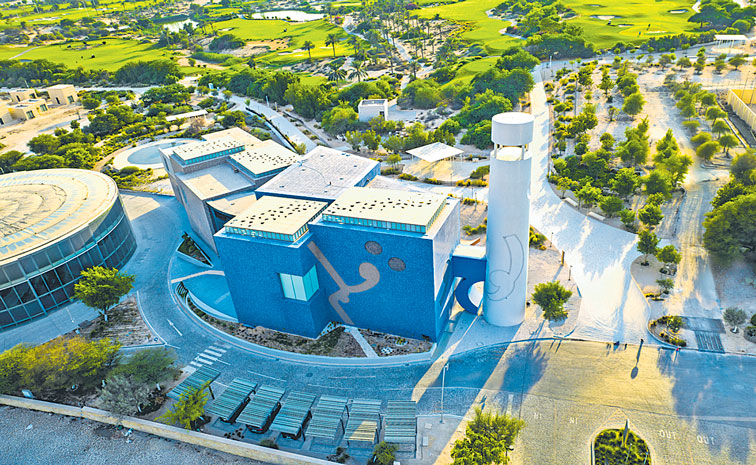
One of the most unique aspects of Lawh Wa Qalam is its architectural origin. The building was designed by Indian architect Martand Khosla, who worked closely with the Qatar Foundation. Surprisingly, the entire design was inspired by just one sketch made by Husain in 2008.
The sketch showed two sculptural masses:
- a vivid blue-grey dwelling
- connected by a cylindrical tower
This drawing did not include measurements or structural details. It was simply an expression of intent. Khosla explains that translating the sketch into a functional, modern museum required deep imagination. Instead of following it as a strict blueprint, he explored it as a philosophical idea.
He asked himself, What is literal here? What is metaphorical?
This question guided the creative process.
The result is a labyrinth-like museum, where corridors turn unexpectedly, shadows shift dramatically, and every corner invites curiosity. Walking through the museum feels like following Husain’s own brushstrokes — unpredictable, bold, and full of discovery.
Inside the Museum: Following Husain’s Footsteps
Each gallery opens with a quote from MF Husain himself. These quotes help visitors step into his mind before experiencing the artworks that follow. The hallways lead into rooms filled with vibrant paintings, dynamic sculptures, and rare personal items.
Some of the standout displays include:
✔ Husain’s Indian Passport
A powerful symbol of his identity, memory, and emotional connection to his homeland.
✔ Rare photographs from his early years
These images portray him not as a controversial public figure, but as a curious artist constantly learning and evolving.
✔ Sculptures and tapestries created during his travels
They reflect how deeply he connected with the world around him.
✔ Film footage from his Bollywood experiments
Although his films did not succeed commercially, they reveal his passion for visual storytelling.
Most importantly, the museum offers the chance to see his horses — the dramatic, flowing forms that became his signature.
The curatorial team spent months gathering oral stories from Husain’s inner circle — his driver, assistants, collaborators, and friends. These stories help visitors see the man behind the legend.
Many people remember him as the eccentric artist who walked barefoot, had flowing white hair, and carried endless energy. Yet those who knew him personally say he was gentle, philosophical, and obsessed with storytelling.
Seeroo fi al ardh: The Masterpiece of His Final Years
One of the museum’s major attractions is Seeroo fi al ardh (Walk in the Land), Husain’s ambitious multimedia project that took up much of his later life.
He imagined it as a story of human civilisation told through:
- movement
- sound
- mechanical installations
- dance-like structures
This work blends technology with art and reflects Husain’s belief that creativity should never remain still.
Visitors describe the installation as hypnotic — an evolving visual journey that captures the motion of history itself. The museum has given this project a special place so visitors can fully immerse themselves in Husain’s vision.
A Deep Dive Into His Arab Civilisation Series
During his time in Qatar, Husain began a major commissioned project from Sheikha Moza bint Nasser, chairperson of Qatar Foundation. The idea was to create 99 paintings depicting the evolution of Arab civilisation.
MF Husain Museum Doha set up a dedicated studio in Doha for this project. What followed was a burst of creativity that expanded his artistic vocabulary.
He painted:
- Islamic astronomers
- Philosophers
- Desert travellers
- Scholars
- Poets
- Warriors
- Sufi mystics
He used the same kinetic lines and dynamic style associated with his Indian works but adapted them to reflect the Gulf’s warm, earthy landscapes. His colour palette expanded into deep ochres, burnt siennas, and glowing golds.
One of the most striking pieces from this series is The Battle of Badr, a foundational moment in Islamic history. In this painting, Husain masterfully captures the emotion, movement, and intensity of the event.
Although he planned to create 99 paintings, he completed only 36 before his death. All 36 are now part of the museum’s rotating collection, giving visitors fresh experiences each time they return.
Why This Museum Matters
The Lawh Wa Qalam museum is more than a tribute to MF Husain. It is an acknowledgment of how deeply intertwined his identity was with different cultures. Although rooted in India, Husain viewed the world with a wide lens. He drew inspiration from mythology, modernism, Islamic history, and global civilisation.
Architect Martand Khosla explains that Husain carried multiple identities simultaneously. His art was shaped by many regions, religions, and narratives. The museum captures that layered identity perfectly.
For India, the museum is a moment of pride. It ensures that one of the country’s greatest artistic voices continues to inspire new generations. For Qatar, it represents a commitment to nurturing global art and honouring the creative spirits who found a home there.
For the world, it stands as a reminder that art knows no borders.
MF Husain Museum Doha: Enduring Impact on Global Art
MF Husain Museum Doha passed away in 2011, but his influence has only grown. His works are displayed in prestigious galleries around the world. Art students still study his lines, his colours, and his unique ability to combine the old with the new.
The Doha museum solidifies his place as a global cultural icon. It allows visitors to experience:
- his early experiments
- his bold middle career
- his deeply reflective final years
Most importantly, it introduces the next generation to an artist who constantly pushed boundaries — whether social, artistic, or emotional.
MF Husain Museum Doha believed that art should provoke thought, spark imagination, and start conversations. The museum continues that mission.
MF Husain Museum Doha That Feels Alive
Unlike many traditional museums where visitors move passively from one display to the next, Lawh Wa Qalam encourages movement and exploration. The architectural design itself reflects Husain’s flowing brushstrokes — full of life, rhythm, and surprise.
Every corner reveals something new. Every gallery invites fresh interpretation. Visitors often describe the experience differently, which is exactly what the creators intended.
Just like Husain’s murals, the museum ensures that no two visits feel the same.
A Celebration of Art, Identity & Imagination: MF Husain Museum Doha
MF Husain’s life cannot be summarised in one story. He was many things at once:
- a painter
- a filmmaker
- a philosopher
- a traveler
- a dreamer
- a controversial figure
- a global citizen
MF Husain Museum Doha captures all these layers with sensitivity and depth. It celebrates an artist who lived fearlessly and painted passionately. It brings together the worlds he loved — India, Qatar, the Gulf, mythology, modernity, and the human experience.
Visitors leave the museum not only with admiration for Husain’s work but with a deeper understanding of his journey. They witness a man shaped by multiple cultures yet anchored by a timeless artistic vision.
Conclusion
The opening of the MF Husain Museum in Doha marks a historic moment for global art. It honours an Indian legend who redefined modern painting and continued creating until his final days.
The museum is a space of reflection, storytelling, and discovery. It brings together 150+ works, personal objects, multimedia displays, and ambitious late-life creations under one roof. It celebrates the artist’s imaginative universe while offering visitors a meaningful experience rooted in history and emotion.
For admirers of Husain, for lovers of art, and for curious minds across the world, this museum stands as a powerful reminder that creativity lives on long after the artist is gone.
