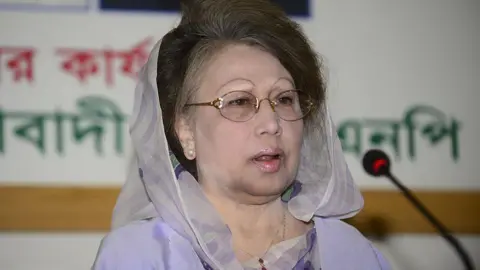
Khaleda Zia death: Bangladesh has entered a moment of profound political reflection following the death of its former prime minister and one of the country’s most influential political figures, Khaleda Zia death, who passed away at the age of 80 after a prolonged illness. Her party, the Bangladesh Nationalist Party (BNP), confirmed that she died early Tuesday morning at Dhaka’s Evercare Hospital, closing a historical era shaped by fierce political rivalry, democratic struggles, and decades of shifting power in South Asia.
The BNP announced her passing with a solemn message, stating, “Our beloved national leader is no longer with us.” The party also urged citizens to pray for her soul and remember her legacy during a time of national reflection. Her death marks the end of a turbulent political chapter dominated by Khaleda Zia and her long-time opponent, Sheikh Hasina—two leaders who profoundly shaped Bangladesh’s political landscape and came to be known as the “battling begums.”
Her medical team reported that she had been suffering from multiple serious health conditions, including advanced liver cirrhosis, diabetes, arthritis, and chronic heart and chest complications. She had been admitted to the hospital on November 23.
Even Bangladesh’s interim leader, Nobel laureate Muhammad Yunus, had addressed the nation days before her death, calling Khaleda a “source of utmost inspiration for the nation” and requesting citizens to pray for her recovery. His remarks underscored the respect she commanded across political lines, despite her polarising public image.
A Long Illness Finally Ends: What We Know About Khaleda Zia’s Final Days
Khaleda Zia death health had been deteriorating steadily for several years. Her long struggle with liver disease and other chronic ailments had required repeated hospitalisation since 2020. According to doctors at Evercare Hospital, her condition became critical during November when she arrived with symptoms of a lung infection. Medical sources indicated that her body was no longer responding to treatment and that her disease had reached an advanced stage.
For years, her party and family had appealed to the government for permission to take her abroad for advanced treatment. However, under Sheikh Hasina’s government, these requests were consistently denied. The refusal itself had become a major political issue, deepening tensions between the ruling party and BNP supporters.
Her release from jail in 2020—initially granted on humanitarian grounds during the COVID-19 pandemic—allowed her to receive care at home, although her mobility and public visibility reduced greatly thereafter.
Bangladeshis, especially BNP supporters, remained emotionally invested in her condition, and public vigils were held several times during her hospitalisations. Many believed she would eventually recover enough to resume a limited political presence. Her death, therefore, was not unexpected but still deeply felt across the political spectrum.
A Political Era Ends: The Significance of Khaleda Zia death in Bangladesh’s History
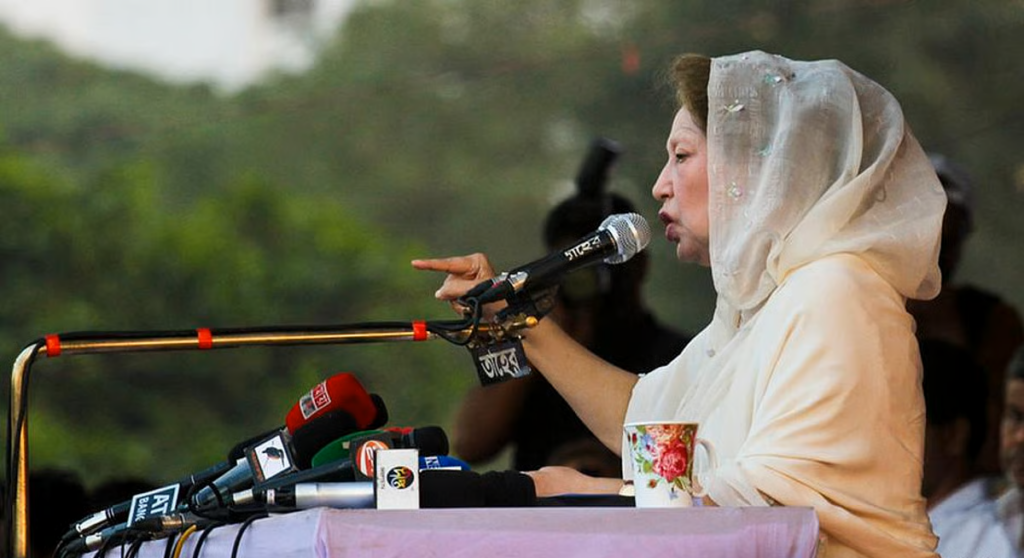
Khaleda Zia death has closed a historical political era defined by her fierce rivalry with Sheikh Hasina. For more than three decades, their competition shaped Bangladesh’s electoral politics, parliamentary debates, national policies, and public life. Their personalities, political ideologies, and leadership styles stood in stark contrast, often leading to nationwide strikes, street movements, and mass demonstrations.
The political conflict between the two leaders became so intense and enduring that they were referred to internationally as the “battling begums.” Their rivalry influenced governance, foreign policy decisions, economic reforms, and political reforms for years.
Khaleda’s departure now leaves BNP in the hands of her son, Tarique Rahman, who returned to Bangladesh just days before her death after 17 years of self-imposed exile. With a general election scheduled for February 12, 2025, Tarique’s return and his mother’s passing will now shape the BNP’s political momentum and emotional appeal.
Political analysts say that Khaleda’s legacy will endure, but the political battlefield will now look significantly different without her presence.
Early Life: From Dinajpur Girl to the Heart of Bangladesh’s Politics
Khaleda Zia was born on August 15, 1946, in Dinajpur, then part of British India’s East Bengal. She grew up in a region that would later become central to Bangladesh’s nationalist movements. Her life took a significant turn at a young age when she married Ziaur Rahman at the age of around 15. Her husband, a rising army officer, later became a military hero during the 1971 Liberation War.
Following independence, Ziaur Rahman assumed the presidency in 1977 and founded the Bangladesh Nationalist Party (BNP) in 1978. His political rise laid the foundation for Khaleda’s future leadership.
However, her entry into politics was unexpected and shaped by tragedy. In 1981, Ziaur Rahman was assassinated in Chittagong during a failed military coup. The incident plunged Bangladesh into political instability and left Khaleda, then a young mother of two, amid national turmoil.
Her husband’s supporters encouraged her to take charge of the BNP. Despite being initially dismissed by opponents as inexperienced, she quickly emerged as a powerful political force. Her calm yet firm political personality helped unify factions within the BNP and positioned her as a major figure in the fight against military dictatorship.
Rise to Power How Khaleda Became Bangladesh’s First Female Prime Minister: Khaleda Zia death
Khaleda Zia gained prominence during the mass movements against President Hussain Muhammad Ershad, a military ruler who maintained power through restrictive laws and political repression. Khaleda joined hands with Sheikh Hasina during the 1980s to oppose Ershad, demonstrating an early moment of unity between the two future rivals.
The fall of the Ershad government in 1990 opened the door for democratic elections. In 1991, Bangladesh held what was widely considered its first free and fair election. Khaleda Zia led the BNP to a stunning victory over Sheikh Hasina’s Awami League.
Upon taking office, she became:
- Bangladesh’s first female prime minister
- Only the second Muslim-majority nation female democratic leader, after Pakistan’s Benazir Bhutto
- A dominant figure in South Asian politics
During her first term, she made several significant reforms, including the transition from a presidential to a parliamentary governance system—a change that remains foundational to Bangladesh’s political structure.
Her administration emphasised foreign investment, primary education, and infrastructural development. She also worked on strengthening Bangladesh’s relations with the United States, China, and Middle Eastern partners.
Political Rivalry Deepens: The Beginning of the Battling Begums Era
The rivalry between Khaleda Zia and Sheikh Hasina intensified through the 1990s. After losing power in 1996, Khaleda accused Hasina’s government of political bias and mismanagement. She mobilized BNP supporters through street protests and election boycotts, which contributed to repeated political standoffs.
In 2001, Khaleda returned to power in a landslide win, surprising even some political observers. Her second term, however, became increasingly turbulent. She faced rising allegations of corruption, escalating political violence, and growing tensions with Hasina’s supporters.
The rivalry reached a breaking point in early 2007, when disputes over election procedures triggered mass protests, leading to the declaration of emergency rule backed by the military. Both Khaleda and Hasina were arrested during the turmoil, although neither leader was formally convicted at the time. Their temporary detentions highlighted the political crisis gripping Bangladesh.
Corruption Charges and Years of Legal Battles
Khaleda Zia’s later political years were overshadowed by legal cases and corruption allegations. In 2018, under Hasina’s administration, Khaleda and her son Tarique Rahman were sentenced to prison for misappropriating funds from an orphanage trust. She consistently denied the charges, calling them a politically motivated attempt to undermine her influence.
Her imprisonment weakened the BNP’s position ahead of the 2018 election, which the party accused the ruling government of manipulating. Khaleda’s supporters viewed her legal troubles as part of a broader strategy to eliminate opposition voices.
However, in early 2025, the Bangladesh Supreme Court acquitted both Khaleda and Tarique of the corruption charges. Tarique was also acquitted in a separate case concerning a 2004 grenade attack on Sheikh Hasina. These rulings dramatically shifted the country’s political climate weeks before the upcoming election.
Khaleda, however, remained frail and unable to fully return to political activity. Her health concerns continued to dominate her final years.
Her Final Political Impact: What Khaleda Leaves Behind
Khaleda Zia leaves behind a complicated legacy—admired by supporters for her resilience and criticised by opponents for her political decisions. Yet her contribution to Bangladesh’s democratic journey remains undeniable.
Her major political achievements include:
✔️ Leading the transition from military rule
Khaleda played a pivotal role in restoring democratic elections after years of authoritarian leadership.
✔️ Strengthening parliamentary governance
She oversaw the constitutional shift from a presidential to a parliamentary system.
✔️ Advancing women in leadership
Khaleda became a symbol of women’s political leadership in a Muslim-majority nation.
✔️ Expanding education and foreign investment
Her policies helped modernise Bangladesh’s economy in the 1990s and early 2000s.
✔️ Providing long-lasting political alternatives
BNP under her leadership stood as a robust opposition to the Awami League.
At the same time, her political life was marked by electoral boycotts, corruption allegations, and street confrontations that occasionally weakened democratic institutions. Nevertheless, even her strongest critics acknowledge her significant role in shaping political discourse.
Tarique Rahman’s Return: What Her Khaleda Zia death Means for the Upcoming Election
Just days before Khaleda Zia death, her son Tarique Rahman returned to Bangladesh after nearly two decades in exile. His return was already a major political event, especially after his unexpected acquittal.
With the February 12 general election approaching, Khaleda Zia death is likely to influence voter sentiment. BNP supporters now rally around Tarique, hoping he will revive the party’s political strength. Analysts believe that Khaleda’s passing could generate a wave of public sympathy, potentially reshaping the electoral landscape.
BNP has announced that Tarique will lead the party into the election and may be nominated for prime minister if they secure a majority. His mother’s legacy will undoubtedly shape his campaign narrative and the party’s vision.
Reactions From Across Bangladesh and the World
Khaleda Zia death has drawn widespread reactions from political leaders, civil society groups, foreign observers, and millions of Bangladeshi citizens. Many have praised her courage during years of political persecution. Others have reflected on the tumultuous political era she represented.
Public gatherings, condolence messages, and statements from international organisations began circulating within hours of the announcement. Even critics noted that her decades of political resilience had influenced South Asia’s democratic movements.
As funeral arrangements move forward, Bangladesh prepares for several days of mourning and political remembrance. Security forces have been placed on alert in Dhaka and major cities to prevent unrest, although early reports suggest that gatherings have so far remained peaceful.
Legacy of the Battling Begums: An Era That Has Now Closed
With Khaleda’s passing and Sheikh Hasina living in exile following her violent ouster in 2024, the “battling begums” era has effectively come to an end. Their rivalry defined Bangladesh’s political identity for decades, shaping everything from governance to public expectations of leadership.
Both women rose from family tragedies, led major political movements, faced imprisonment, and shaped the country’s foreign and domestic policies. Their names became synonymous with political determination.
Khaleda’s absence will transform the political landscape. Bangladesh now enters a new phase—led by new generations, fresh ideologies, and changing priorities. Whether the nation will move toward greater unity or continue experiencing deep political divisions remains to be seen.
Conclusion: Khaleda Zia death A Historic Leader’s Final Chapter
Khaleda Zia death marks the end of a powerful chapter in Bangladesh’s history. Her journey—from a young woman thrust into leadership after her husband’s assassination to becoming the nation’s first female prime minister—remains one of the most remarkable political stories in South Asia.
Her resilience, political battles, and public service shaped the nation for over three decades. Although her career was filled with controversy, her contribution to Bangladesh’s democratic evolution is significant and enduring.
As the country prepares for a crucial general election, Khaleda’s legacy now becomes part of Bangladesh’s political memory. Her supporters mourn a leader they adored. Her critics reflect on the impact she had on national politics. And the nation looks ahead to a future shaped in part by the path she helped build.
