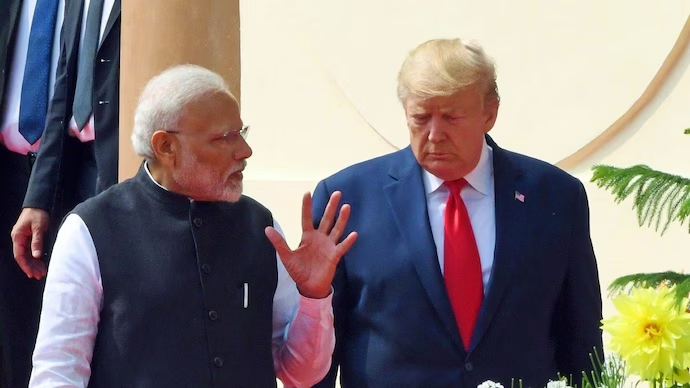
The United States has described the ongoing India–US trade talks as some of the most promising negotiations in recent years, signalling what officials call a “historic opening” by New Delhi across sensitive agricultural and industrial sectors. The remark, made by US Trade Representative (USTR) Jamieson Greer during a Senate Appropriations subcommittee hearing, marks a major shift in how Washington views its commercial engagement with India—a country often considered a tough market for American exporters.
Greer told lawmakers that India has delivered “the best offers we’ve ever received as a country”, particularly in relation to market access for agricultural commodities such as sorghum, soy, and other US-grown row crops. His comments reflect accelerated diplomatic and commercial engagement between the two major economies as global supply chains reconfigure and the United States seeks reliable alternatives to China.
Over the past decade, India–US trade relations have expanded rapidly across technology, aviation, agriculture, critical minerals, and digital services. However, agriculture remains a longstanding challenge because of India’s tariffs, regulatory standards, and domestic sensitivities. Greer’s statement indicates a shift that could redefine bilateral trade for years to come.
US Trade Representative Highlights India’s “Forward-Leaning” Approach
During the Senate hearing, Greer emphasized that a USTR team was actively negotiating in New Delhi, underscoring the seriousness of the discussions. Acknowledging that India has historically been resistant to opening markets for certain crops, he emphasized that New Delhi’s latest proposals were unusually progressive.
“They’ve been quite forward-leaning,” Greer said, responding to questions from senators concerned about limited export options for American farmers.
This shift is especially meaningful at a time when US producers are battling:
- Excess grain inventories
- Sluggish demand from China
- Falling commodity prices
- Volatile tariff environments
India, with its massive consumer market and growing food demand, has emerged as a “viable alternative market” according to Greer.
Why American Farmers Are Looking Toward India
The agricultural sector in the United States has been under immense pressure due to weakened global demand and fluctuating export markets. China, once the largest buyer of several American farm goods, has reduced or delayed purchases due to geopolitical tensions and shifting trade strategies.
This environment has encouraged US officials to diversify export destinations.
Key Reasons India Matters to US Agriculture
1️⃣ Large and Growing Market
India’s population and rising middle class make it one of the world’s fastest-growing consumer markets.
2️⃣ Demand for Protein-Rich and Feed-Based Crops
Crops like soy, sorghum, and corn are crucial for India’s livestock, poultry, and ethanol industries.
3️⃣ Strategic Diversification
Reducing dependence on China has become a top economic priority for US farm states.
4️⃣ Improved Bilateral Engagement
The US–India Strategic Trade Dialogue has accelerated negotiations and softened resistance in several sectors.
Senator Jerry Moran, representing Kansas—a major sorghum and soy-producing state—pressed Greer on US plans to expand global market access.
“It’s such a difficult country to crack,” Moran said, noting India’s complex trade regulations.
Greer responded optimistically, saying the current administration is further along with India than ever before.
Aviation, Tariffs, and Industrial Goods Also on the Table
While agriculture dominated much of the conversation, Greer confirmed that broader tariff and market-access issues were being negotiated simultaneously. One area gaining attention is the 1979 Aircraft Agreement, which governs zero-tariff treatment for civil aviation parts.
Greer said discussions with India were “fairly far advanced,” suggesting expansion of tariff-free access could be possible if India reciprocates with market-opening commitments.
In plain terms:
→ India is seeking industrial opportunities
→ The US is seeking agricultural and regulatory concessions
→ Both sides see value in balanced trade expansion
Energy and Ethanol: New Frontiers in India–US Trade Talks
Senator Moran highlighted India’s potential as a major buyer of ethanol derived from US corn and soy. Ethanol is increasingly important as countries adopt cleaner fuel standards and search for renewable energy alternatives.
Although Greer did not elaborate specifically on India’s stance, he said:
- Many countries were opening markets for US ethanol
- The EU committed to buying $750 billion in US energy products, including biofuels
- Such global initiatives strengthen America’s negotiating position with India
If India expands ethanol imports, US farm states could benefit significantly, especially those producing corn and soy.
A Global Trade Reorientation Strengthens India–US Cooperation
The Biden administration has been pushing a global realignment of trade, focusing on:
- Lowering trade deficits
- Opening markets in Southeast Asia
- Strengthening ties with Europe
- Building alternative supply chains beyond China
Greer explained that these parallel negotiations make the United States a more attractive partner, increasing leverage with major markets like India.
In this context, India’s recent proposals represent a strategic alignment, as New Delhi also seeks:
- Diversification away from China
- Stronger partnerships across the Indo-Pacific
- A larger role in global manufacturing
- Investment in clean energy, digital trade, and pharmaceuticals
This geopolitical overlap has created momentum for deeper commercial ties.
Pharmaceuticals and Regulatory Access: A Hidden Priority
Greer noted that beyond agriculture, the United States is aggressively pushing for:
- Lower regulatory barriers
- Faster FDA acceptance of US-made medicines
- Transparent approval processes
- Stronger intellectual property frameworks
India is one of the world’s largest pharmaceutical exporters, and the American medical market is a major destination for Indian generics. However, the United States wants reciprocity, especially to protect high-value American biotech and innovative medicines.
These discussions are taking place parallel to agricultural talks, creating a multi-layered negotiation framework.
Economic Pressures Are Driving US Policy
Multiple senators expressed concerns about the uncertain future of American agriculture, citing:
- Rising costs
- High input prices
- Decreasing crop values
- Delays in Chinese purchases
- Weather-related disruptions
Greer stressed that the administration’s strategy of reciprocal trade agreements is designed to create new opportunities for exporters.
“We are breaking the mold of conventional wisdom in Washington,” he said.
His comments reflect an administration determined to expand global market access even through aggressive tools such as:
- Tariffs
- Enforcement mechanisms
- Trade rebalancing
- Sector-specific negotiations
Enforcement Remains a Core Strategy in India–US Trade Talks
Greer reiterated that strict enforcement is essential for maintaining trade commitments.
“They respond to enforcement,” he said. “That’s how we’re able to generate compliance and market opening.”
This signals that the United States is prepared to:
- Apply pressure
- Use tariff tools
- Push hard for transparency
- Demand real concessions
Despite this, India has shown willingness to negotiate, which Greer called “surprising and constructive.”
New US Visa Rule Sparks Panic Among Indians as Social Media Checks Begin
Historical Context: Why India–US Trade Talks Matter More Today
Over the last decade, bilateral trade has grown significantly, reaching new highs across sectors such as:
- Digital technology
- Aerospace
- Defense
- Agriculture
- Renewable energy
- Pharmaceuticals
- Critical minerals
However, both nations have grappled with:
- Tariff disagreements
- Sanitary and phytosanitary regulations
- Data governance issues
- Market access restrictions
- Long approval timelines
Recent geopolitical realignments—particularly in the Indo-Pacific—have accelerated cooperation and made trade a top priority.
India and the US now view each other as:
- Strategic partners
- Supply-chain allies
- Technology collaborators
- Defense and security partners
- Critical geopolitical counterweights
This shift explains why the current trade negotiations have gained unusual urgency and optimism.
Deep Dive: Sectors Likely to Benefit From India–US Trade Talks
1️⃣ Agriculture
Major beneficiaries may include:
- Sorghum
- Soybeans
- Corn
- Dairy products
- Animal feed
- Poultry inputs
2️⃣ Aviation and Industrial Goods
Updates to tariff structures under the 1979 Aircraft Agreement could boost:
- US manufacturers of aviation parts
- India’s growing aviation market
- Joint aerospace collaborations
3️⃣ Pharmaceuticals & Regulatory Cooperation
Mutual benefits include:
- Faster approvals
- Standardized regulations
- More predictable market access
4️⃣ Energy & Ethanol
India’s push for clean fuel standards opens opportunities for:
- US corn-based ethanol
- Renewable energy products
- Biofuel technology partnerships
5️⃣ Digital Trade & Critical Minerals
Although not publicly detailed, both countries are negotiating frameworks related to:
- Semiconductor supply chains
- Digital services
- AI governance
- Rare-earth minerals
These sectors represent the future of the global economy.
How India–US Trade Talks Impact American Farmers
For US growers facing oversupply and weak demand, India offers:
- A new market of over 1.4 billion consumers
- A rapidly expanding food processing sector
- Strong demand for animal feed and ethanol inputs
Farm states such as:
- Kansas
- Iowa
- Nebraska
- Illinois
- Minnesota
…are closely watching the outcome of these negotiations.
If India reduces barriers on row crops, it could ease the pressure on commodity prices and help stabilize farm incomes.
How India Benefits From Opening Its Markets
While the United States seeks agricultural access, India stands to gain from:
✔ Increased investment
US companies are exploring manufacturing, aviation, renewable energy, and healthcare sectors.
✔ Greater access to American technologies
Particularly in:
- Aerospace
- Clean energy
- Pharmaceuticals
- Digital infrastructure
✔ Stronger geopolitical alignment
A deeper partnership enhances India’s position in the Indo-Pacific region.
✔ Supply chain diversification
India seeks to become a global alternative to China, and cooperation with the US accelerates that shift.
Challenges That Could Slow Progress
Despite progress, several obstacles remain:
- India’s need to protect domestic farmers
- Differing regulatory standards
- Tariff sensitivities
- Political timelines in both countries
- Approval processes for agricultural imports
- Pressure from competing domestic interests
Still, both sides appear unusually committed to overcoming these issues.
India–US Trade Talks Enter a Transformative Phase
The latest statements from US Trade Representative Jamieson Greer mark one of the most significant milestones in India–US trade talks in recent memory. India’s willingness to provide unprecedented access for American agricultural goods, paired with the United States’ interest in expanding cooperation across aviation, energy, and pharmaceuticals, signals a transformative moment in bilateral relations.
Both countries are aligning strategically—economically, politically, and technologically—to navigate a shifting global landscape. As negotiations intensify, the coming months could reshape trade architecture between the world’s largest democracies.
For exporters, industries, policymakers, and consumers, the outcomes of these talks could define global commerce in the Indo-Pacific for years to come.
