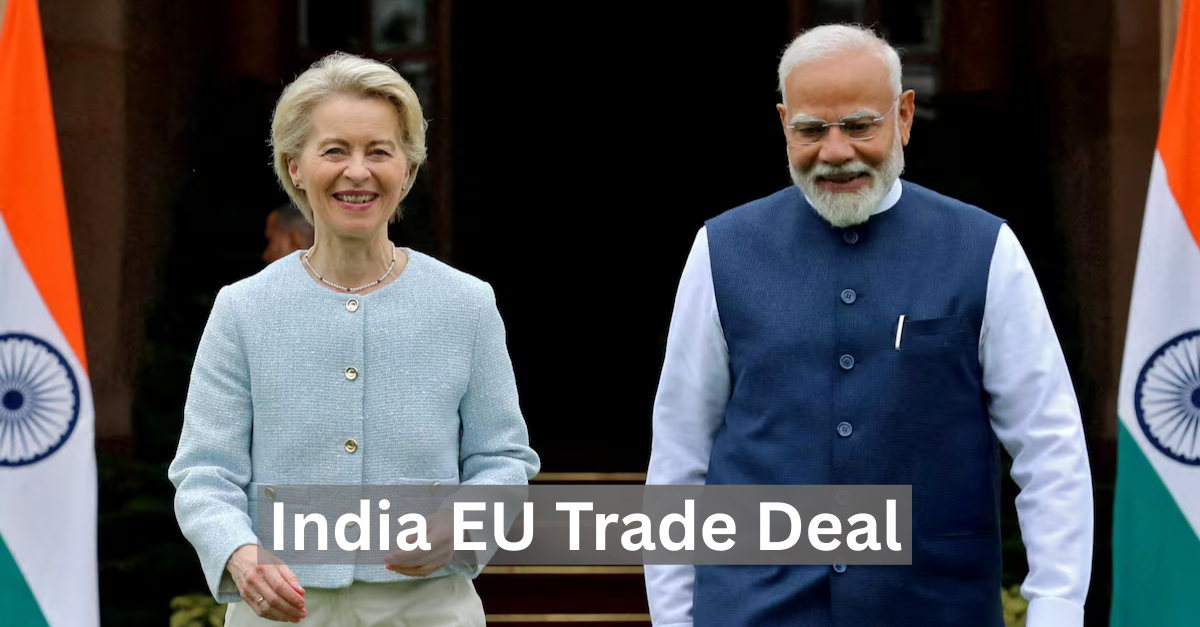
The world is witnessing a major shift in global trade, and the upcoming India EU trade deal is at the center of this transformation. As geopolitical tensions rise and tariff uncertainties grow, both India and the European Union are preparing to conclude what leaders are calling the “mother of all deals.” This free trade agreement (FTA) has been under negotiation for nearly two decades, but the timing of its revival carries powerful symbolism and strategic value for both sides.
With European Council President Antonio Luis Santos da Costa and European Commission President Ursula von der Leyen attending India’s Republic Day celebrations, the stage is set for a breakthrough. Beyond ceremonial events and traditional banquets, the two sides are expected to finalize conversations that could trigger a new chapter in global economics and diplomacy.
Why the India EU Trade Deal Matters Now
A sweeping FTA between India and the EU arrives at a time when global trade has become unpredictable. Rising tariff risks, protectionist policies and evolving alliances are forcing nations to rethink their economic strategies.
Recent tensions related to US tariff policies have pushed India to diversify its partnerships. At the same time, Europe is searching for dependable markets as it seeks to reduce its reliance on China. In that environment, the world’s fourth-largest economy—India—has emerged as a natural fit.
Both sides are now motivated by urgency:
-
India wants stable, large-scale markets to counter tariff threats from the US.
-
The EU wants reliable partners as it reduces exposure to China’s supply chain dominance.
This alignment of priorities is the strongest reason the deal is finally reaching its last stages.
A Market of Two Billion People
If signed, the India EU trade deal would create one of the world’s largest free markets. Together, India and the EU represent:
-
Over 2 billion consumers
-
About 25% of global GDP
-
A combined economy worth more than $25 trillion
This scale alone makes the pact an economic powerhouse.
India is expected to cross the $4 trillion GDP mark, overtaking Japan and expanding its global influence. For Europe, engaging with such a fast-growing economy strengthens its access to Asian markets at a time when global supply chains are being redesigned.
Related News: New Zealand India Free Trade Agreement: A Historic Deal Aimed at Doubling Trade
How the India EU Trade Deal Benefits India
The European Union is already India’s largest trading bloc. India exported nearly $76 billion worth of goods to the EU while importing around $61 billion, giving Delhi a healthy trade surplus. However, when the EU removed India from the Generalised System of Preferences (GSP) in 2023, several Indian exports became less competitive.
The FTA could change that dramatically.
Key Advantages for India
-
Restoring market access lost due to the removal of GSP benefits
-
Lower tariffs on major exports such as textiles, pharmaceuticals and machinery
-
Better resilience against US tariff fluctuations
-
Wider opportunities for micro, small and medium enterprises (MSMEs)
Sectors like steel, petroleum products and engineering goods are expected to receive a significant boost.
At the same time, India plans to shield sensitive areas such as agriculture and dairy—industries that deeply affect domestic livelihoods. Negotiators have been clear that tariff reductions in these areas, if considered at all, would be phased in very gradually.
What Europe Gains from the Deal
Europe stands to benefit equally from the agreement. Its advanced sectors—automobiles, high-end machinery, spirits and wine—could gain easier access to the Indian market.
Europe’s Key Objectives
-
Secure strong intellectual property protections
-
Enhance data protection standards
-
Establish predictable norms for digital trade
-
Reduce tariff barriers for EU exports
For Europe, the India EU trade deal is not just economic—it is strategic. As concerns grow over supply chain dependence on China, diversifying into India offers European companies long-term security.
The Carbon Border Tax: A Major Sticking Point
One of the biggest challenges in the negotiations is Europe’s new Carbon Border Adjustment Mechanism (CBAM). This mechanism imposes carbon-related charges on imported goods from countries without strong emissions controls.
For many Indian exporters, especially MSMEs, this is more than a tax—it is a compliance burden.
Why India Opposes CBAM
-
High reporting and documentation costs
-
Complex emissions calculations
-
Risk of penalties based on default emission values
-
Fear that CBAM could offset tariff reductions under the FTA
India has expressed that the carbon tax “acts like a new tariff,” making some of its exports less competitive despite the free trade agreement.
Finding a mutually acceptable solution here will decide the final shape of the deal.
Political Significance of the India EU Trade Deal
While economics is at the heart of the FTA, politics plays a major supporting role. The choice of European leaders as Republic Day guests sends a clear message: India is determined to strengthen global partnerships beyond the shadow of any single global power.
Analysts believe the deal also signals a gradual shift in global alignments:
-
India is reducing dependence on US market access.
-
Europe is reducing dependence on Chinese supply chains.
-
Both want stable long-term partners in an unstable world.
This shared need for dependable alliances makes the India EU trade deal far more relevant than earlier rounds of negotiations.
Could the Deal Face Opposition?
While prospects look positive, some concerns still remain.
European concerns include:
-
India’s high carbon emissions
-
Human rights considerations
-
Market access delays for European firms
Indian concerns include:
-
CBAM compliance costs
-
Intellectual property pressures
-
Risks to sensitive agricultural sectors
However, experts believe that India’s reduction in Russian oil imports and Europe’s need for stable partners will help the deal pass political scrutiny.
Why Analysts Call It a “Win-Win” Deal
Most long-term forecasts suggest that the India EU trade deal will reshape global commerce. The partnership promises economic stability, growth expansion and reduced vulnerability to tariff shocks across markets.
Key Long-Term Benefits
-
Stronger political cooperation
-
Safer global supply chains
-
Reduced dependence on unpredictable partners
-
Increased investment flows between India and the EU
-
Enhanced resilience for industries on both sides
Ultimately, the deal highlights a broader global realignment—nations now prefer stable trade partnerships over unpredictable economic relationships.
Conclusion: A Defining Deal for the Next Decade
The India EU trade deal is poised to become one of the most influential agreements of the modern era. It blends strategy, economics and geopolitical necessity at a moment when the world’s trade landscape is undergoing dramatic shifts.
If the final round of negotiations successfully resolves the remaining sticking points—especially CBAM and intellectual property—the pact could boost growth, strengthen supply chains and reshape global trade dynamics for decades.
The “mother of all deals” is not just a trade agreement. It is a statement of intent—one that signals how India and the European Union plan to navigate a rapidly changing world.
