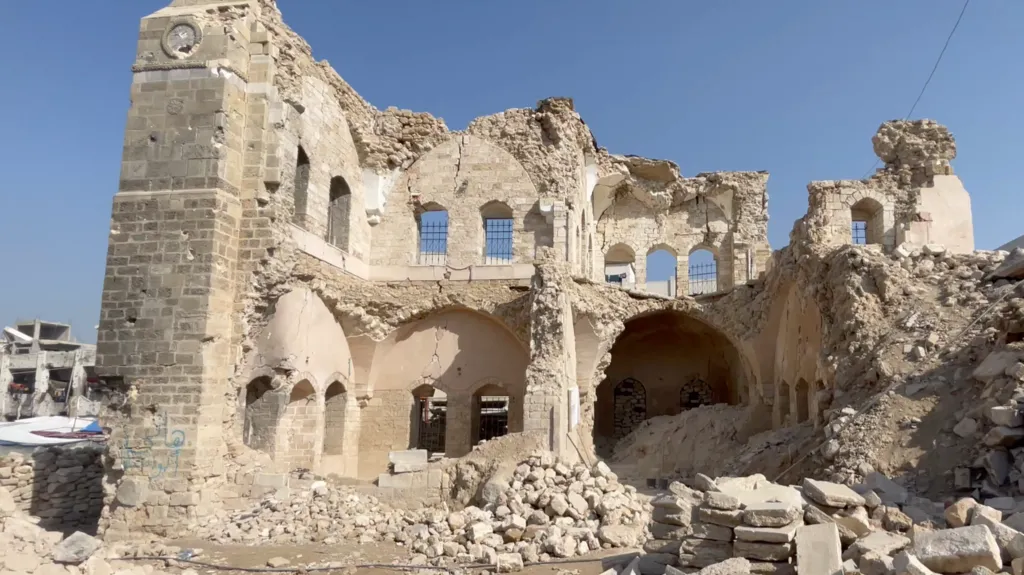
Gaza heritage restoration: Amid the shattered remains of Gaza’s most historic landmarks, Palestinian restoration teams have begun the difficult task of saving what is left of their cultural heritage. One of the most significant efforts is taking place at the Great Omari Mosque in Gaza City — a medieval structure whose iconic octagonal minaret and ancient stone walls were destroyed during nearly two years of war.
Slow but Determined Progress at the Great Omari Mosque
Wearing helmets and protective vests, dozens of workers carefully lift rubble stone by stone. Only parts of the mosque’s outer walls and the broken base of its minaret still stand. Engineers say the restoration is moving slowly because essential construction materials remain scarce. Under the current US-brokered ceasefire, Israel restricts the entry of cement, iron, and other building supplies into Gaza.
Hosni al-Mazloum, an engineer with the Palestinian heritage organisation Riwaq, explains:
“We are working with extremely limited resources. Iron, cement, and other materials simply do not enter Gaza. Every stone must be handled with care — some are more than a thousand years old.”
Despite these constraints, teams continue the painstaking work, driven by a shared commitment to preserve the mosque’s long history.
Rescuing Gaza’s Ancient Manuscripts: Gaza heritage restoration
Not far from the mosque, another team is racing to save ancient Islamic manuscripts pulled from the ruins of the Great Omari Mosque’s historic library. Conservationist Hanin al-Amsi describes the work as “first aid for manuscripts.”
Her team has spent months recovering fragile pages from the rubble. Some manuscripts survived thanks to a preservation project completed before the war, where thousands of pages were digitised and stored in protective boxes and iron safes.
Out of 228 manuscripts, 148 were found intact or partially intact. Some appeared untouched, while others survived only as tiny burnt fragments.
Recent access to deeper sections of the destroyed library revealed that the entire archival collection — including rare Ottoman-era documents — was completely burned.
Accusations and Counter-Claims About Cultural Destruction
Palestinian heritage officials accuse Israel of intentionally targeting historic sites, calling it a violation of international law. Israel denies the allegation and says it strikes only military targets, adding that Hamas operates beneath or near cultural locations.
Regarding the Great Omari Mosque, the Israeli military claims it hit a tunnel shaft used by militants.
Since October 2023, UNESCO has confirmed damage to 145 cultural and historical sites in Gaza. Local experts believe the actual number is even higher.
Restoration Efforts at the 800-Year-Old Pasha’s Palace: Gaza heritage restoration
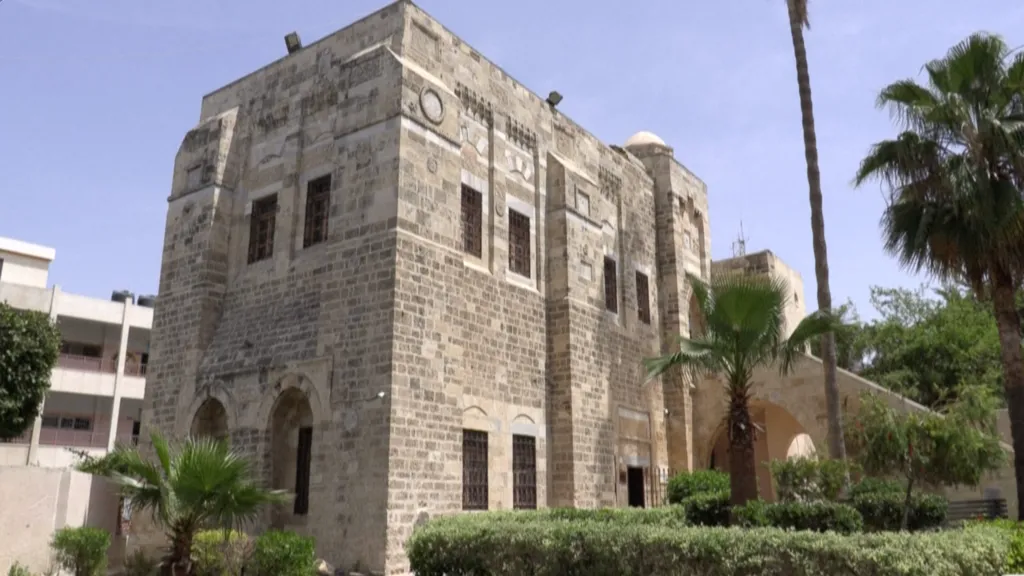
In Gaza City’s Old City, another team works to preserve what little remains of Pasha’s Palace, an 800-year-old landmark once visited by Napoleon Bonaparte in 1799. Before the war, it served as a museum and stored nearly 17,000 archaeological artifacts.
Today, workers carefully remove sand, broken stones, and mortar to uncover surviving mosaic floors and ancient walls.
Dr. Hamouda al-Dahdar, who leads the restoration effort, says:
“This palace represents the collective identity and memory of the Palestinian people. We are committed to preserving whatever is left.”
Only about 30 artifacts have been recovered so far, highlighting the massive scale of loss.
International Support Continues, but Access Remains Difficult
Several global organisations have offered emergency assistance:
- The Aliph Foundation has provided $700,000 in support since 2024.
- The British Council is assessing structural risks and planning future restoration work.
However, many important sites remain inaccessible. Israeli military control prevents archaeologists from reaching areas like Roman cemeteries and the Byzantine Church near Jabalia, which lie within the 53% of Gaza still restricted.
Meanwhile, thousands of displaced families are sheltering at the site of the ancient Greek port of Anthedon, blocking access for conservation teams.
A Small but Significant Sense of Hope: Gaza heritage restoration
Although political uncertainty surrounds Gaza’s future reconstruction, restoration teams continue their work with determination. Their early progress at the Great Omari Mosque and Pasha’s Palace offers a rare sense of hope to people who have witnessed immense loss.
Gaza’s heritage spans more than 5,000 years, shaped by civilisations such as the Canaanites, Egyptians, Byzantines, Mamluks, and Ottomans. By clearing rubble and preserving ancient stones, workers are not only rebuilding history — they are rebuilding identity, memory, and culture.
