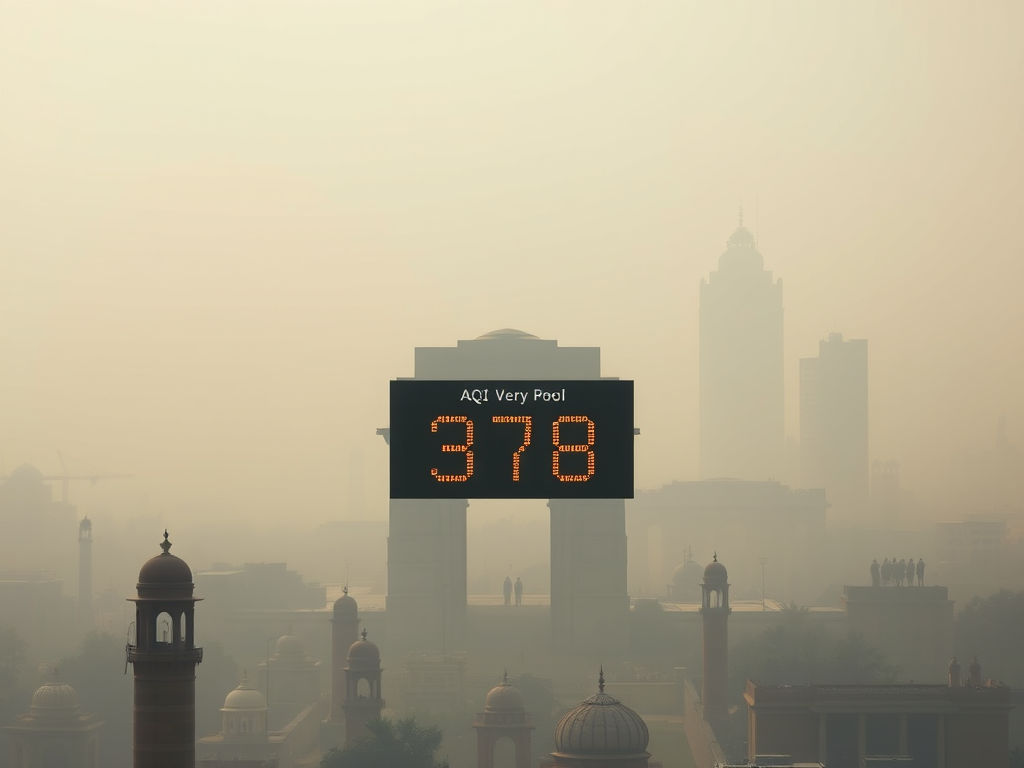
Delhi Air Quality: Delhi continued to experience severe pollution on Tuesday morning as the city’s overall Air Quality Index (AQI) registered 378, placing it firmly in the ‘very poor’ category. Although the reading improved slightly from Monday’s AQI of 427, which had slipped into the ‘severe’ range, the air quality still posed significant risks to public health, visibility, and essential services.
The latest data from the Central Pollution Control Board (CPCB) revealed that despite the minor decline, pollution levels remained alarmingly high across many regions within the National Capital Region. A thick layer of smog blanketed the city, prompting health concerns, travel delays, and renewed administrative activity aimed at controlling vehicular and industrial emissions.
The Focus Keyphrase: Delhi Air Quality
Delhi Air Quality Shows Marginal Improvement but Stays ‘Very Poor’
The slight reduction in the AQI brought little relief to residents who have struggled with worsening pollution over the past several weeks. Delhi’s environment continues to fluctuate between the ‘very poor’ and ‘severe’ categories, especially during winter months when temperature inversion, crop residue burning, industrial emissions, and vehicular pollution combine to deteriorate air quality.
Many prominent locations across the capital recorded AQI readings close to or above 350, reflecting the widespread intensity of pollution. India Gate reported an AQI of 380, while Sarai Kale Khan recorded 359, both categorised as ‘very poor’ by CPCB standards. In the eastern parts of the city, Ghazipur and Anand Vihar posted AQI levels of 410, placing them in the ‘severe’ category.
These figures indicate that although the overall average AQI dipped marginally, pockets of extreme pollution remain.
Understanding Delhi Air Quality Levels
Delhi’s air quality is monitored using the AQI scale, which categorises pollution levels into six bands:
- 0–50: Good
- 51–100: Satisfactory
- 101–200: Moderate
- 201–300: Poor
- 301–400: Very Poor
- 401–500: Severe
The current AQI of 378 clearly positions Delhi’s air quality in the ‘very poor’ category, signalling potential health impacts for vulnerable populations, especially children, senior citizens, and individuals with respiratory or cardiac conditions.
Even healthy individuals may experience irritation in the throat and eyes or difficulty breathing due to prolonged exposure.
Residents Struggle With Smog, Low Visibility and Health Concerns
The city woke up to dense smog, which significantly reduced visibility and triggered numerous health complaints. Many residents reported discomfort while commuting during early hours. The thick haze made it difficult for pedestrians and motorists to navigate through several parts of the city.
A tourist visiting Delhi shared his experience with ANI, mentioning that he faced breathing difficulties soon after arriving. According to him, visibility was so poor that he could hardly see India Gate, one of the city’s most prominent landmarks. His comments echoed the concerns of thousands who continue to face the impact of prolonged exposure to toxic air.
The persistent smog did not simply cause inconvenience; it also posed severe risks to individuals with asthma, bronchitis, or other respiratory illnesses. Hospitals across Delhi and the NCR often report a surge in patients complaining of respiratory problems during these conditions.
Delhi Air Quality Impacts Flight Operations at IGI Airport
The visibility issue extended beyond roads and public spaces. The Indira Gandhi International (IGI) Airport issued a fog advisory early Tuesday morning, warning passengers about potential disruptions to flight schedules.
In a post shared on X at 6:06 AM, airport authorities stated:
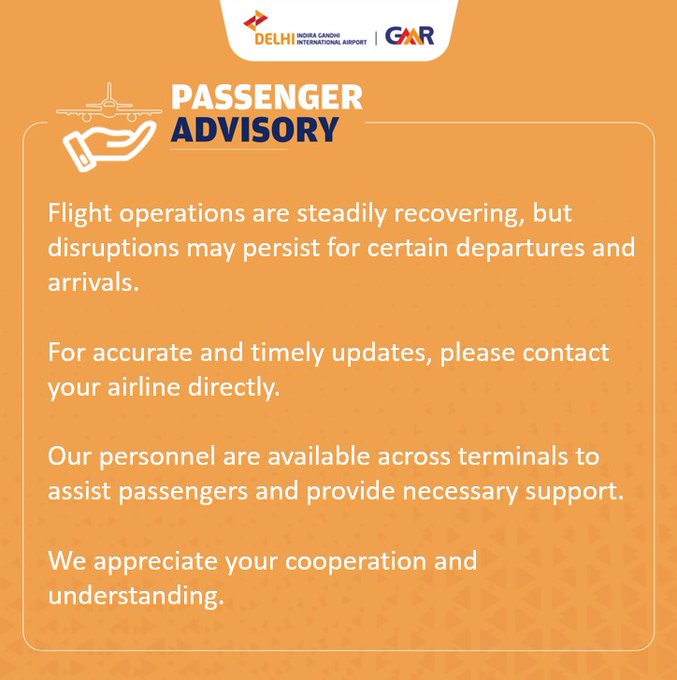
“Flight operations are steadily recovering, but disruptions may persist for certain departures and arrivals.”
Passengers were advised to contact their airlines directly for updates regarding flight status. The advisory highlighted that operations could remain affected due to low visibility caused by fog mixed with smog. Airport personnel remained deployed across terminals to assist travellers, ensuring they received guidance and support.
This response was crucial as air traffic often becomes significantly affected during severe pollution events, leading to delays, diversions, or cancellations.
Delhi Air Quality Decline Mirrors Pollution Trends Across India
While Delhi continues to struggle with hazardous conditions, other major Indian cities reported comparatively better air quality.
Here is the AQI recorded in key cities:
- Ahmedabad: 117
- Bengaluru: 104
- Chennai: 135
- Hyderabad: 103
- Mumbai: 109
- Jaipur: 187
- Lucknow: 158
- Patna: 156
- Pune: 194
Most of these cities fell within the ‘moderate’ or ‘satisfactory’ categories, demonstrating a wide gap between Delhi’s air conditions and the national average. The data underscores the severity of pollution within Delhi and its surrounding regions.
Expert Committee of CAQM Meets to Discuss Vehicular Emissions
The persistent decline in Delhi air quality has prompted multiple government bodies to intensify their efforts to address pollution sources. On Monday, the Commission for Air Quality Management (CAQM) convened the first meeting of its Expert Committee on vehicular emissions in Delhi-NCR.
Chaired by Ashok Jhunjhunwala and co-chaired by Prof. Randeep Guleria, the meeting featured discussions on key contributors to vehicular pollution. The committee evaluated:
- Segment-wise emission contributions
- Exposure risks
- Readiness for electric vehicle (EV) adoption
- Infrastructure needs for sustainable transition
The CAQM stated that the committee will develop concrete recommendations aimed at reducing vehicular pollution. These recommendations are expected to be implemented in the coming months as part of a broader effort to combat the deteriorating air quality.
GRAP Stage IV Restrictions Imposed Amid Dangerous Air Levels
Delhi’s AQI recently crossed 450, touching the ‘severe plus’ category. In response, CAQM activated Stage IV restrictions of the Graded Response Action Plan (GRAP).
These restrictions include:
- Ban on entry of polluting trucks
- Suspension of construction activities (except essential projects)
- Limitations on diesel-heavy commercial vehicles
- Restrictions on industrial operations that do not use clean fuels
GRAP Stage IV is the most stringent phase and is implemented only when pollution reaches emergency levels. Its activation reflects the critical situation faced by Delhi and the urgency required in implementing corrective measures.
Delhi Government Directs Schools to Shift to Online Classes
In view of the hazardous air quality, the Delhi Government issued a circular instructing schools to transition from hybrid learning to fully online classes for students up to Class 5.
The shift aims to protect young children who are particularly vulnerable to air pollution. Schools were advised to continue online instruction until further notice.
This move aligns with previous actions taken during similar pollution spikes in recent years.
Why Delhi Air Quality Worsens During Winter
Although this piece maintains a neutral tone, it is essential to highlight the scientific explanation behind the seasonal worsening of Delhi’s air.
Several factors contribute to this trend:
1. Stubble Burning
Crop residue burning in Punjab, Haryana, and parts of Uttar Pradesh significantly increases particulate matter that drifts into Delhi due to favourable wind patterns.
2. Low Wind Speed
During winter, reduced wind circulation prevents pollutants from dispersing, causing them to remain trapped near the surface.
3. Temperature Inversion
Cold air near the ground creates a barrier that traps warm air and pollutants above it, preventing vertical movement.
4. Vehicular and Industrial Emissions
With nearly 1.2 crore vehicles, Delhi has one of the highest vehicle densities globally. Industrial belts around NCR add to the pollution load.
5. Construction Dust
Large-scale construction activities release dust, especially when moisture levels drop.
These factors collectively push the AQI into unhealthy ranges every winter.
Delhi Air Quality Continues to Raise Public Health Concerns
Doctors across Delhi have warned that prolonged exposure to poor air quality can lead to:
- Asthma attacks
- Chronic bronchitis
- Lung inflammation
- Eye irritation
- Reduced immunity
- Long-term respiratory illnesses
Children, pregnant women, and the elderly face greater risks. Public health advisories encourage residents to stay indoors when possible, use masks, and purify indoor air.
Despite minor improvements, the current AQI remains high enough to cause adverse effects even among healthy individuals.
Delhi Air Quality Trends Require Stronger Administrative Measures
The city has historically implemented several pollution control measures, including:
- Odd-even vehicle rationing
- Bans on firecrackers
- Closure of brick kilns using outdated technology
- Mandatory use of cleaner fuels for commercial vehicles
- Intensification of smog tower operations
However, long-term solutions require coordinated action across states, technological upgrades, and behavioral shifts.
The Expert Committee’s work, GRAP enforcement, and school precautions highlight the ongoing efforts to address Delhi’s environmental conditions.
Delhi Air Quality Remains a Serious Challenge
Delhi’s AQI dropping from 427 to 378 represents marginal improvement, yet the situation remains critical. Residents continue to face smog, health hazards, and disruption to daily activities. While authorities are implementing emergency measures, stable improvement requires structural reforms, cross-state collaboration, technological integration, and public participation.
The ongoing work of CAQM, the Delhi Government’s school advisory, and increased monitoring across the NCR reflect the urgency of addressing this persistent environmental concern.
Until sustainable solutions are fully adopted, Delhi’s winter months will continue to pose significant risks linked to poor air quality.
